Adrian Mateos told Raise Your Edge founder Benjamin “Bencb” Rolle that players who copy solver outputs are making “a big mistake”, in a podcast published on 31 October 2026, eight days after he won the 2026 Poker Masters Purple Jacket in Las Vegas.
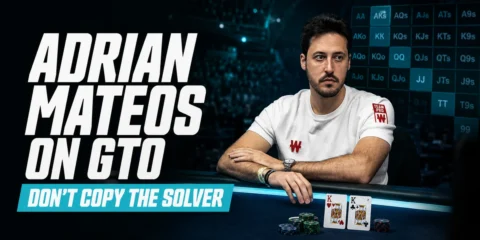
The man saying it is six-time WSOP bracelet winner Adrian Mateos, who has more than $67 million in live earnings according to The Hendon Mob. He also has a fold of pocket kings from the 2024 WSOP Main Event that he still calls a theoretical blunder.
To him the solver is a baseline to deviate from, not an answer to copy. The generation after him, he said, skips the two questions he grew up on: what does my opponent have, and how often do I need to win?
Where Adrian Mateos Stands on GTO & Solvers
Mateos learned the game before solvers existed and treats that as an advantage over the generation that followed. The newer pros, in his telling, go straight to the output. “They just try to copy solver outputs, which I think is a big mistake,” he said.
The Wrong Premise Gives the Wrong Output
The fault, as he sees it, sits in the inputs. A solver answers the question it is asked, and if the ranges fed into it do not match the opponent in the seat, the answer is wrong before anyone reads it.
He also sees the solver used as cover. Players who hate folding rivers find a sim that calls some fraction of the time and tell themselves it was fine. “They prefer to sleep well,” he said.
His host agreed from the coaching side: two-time bracelet winner Benjamin Rolle said the players he works with use GTO as an excuse for their mental leaks, with hero calls justified by a sim after the fact. The full conversation runs to 82 minutes, with the kings fold at 34:25.
None of this makes Mateos an instinct player. He wants the theory as a reference point, and he was just as blunt about random exploits with no baseline underneath.
“If I don’t know I need to open 50% on the button, I cannot exploit by opening 60%,” he said. The baseline he means is covered in how to study GTO and apply solver outputs.
The Pocket Kings Fold, in His Own Words
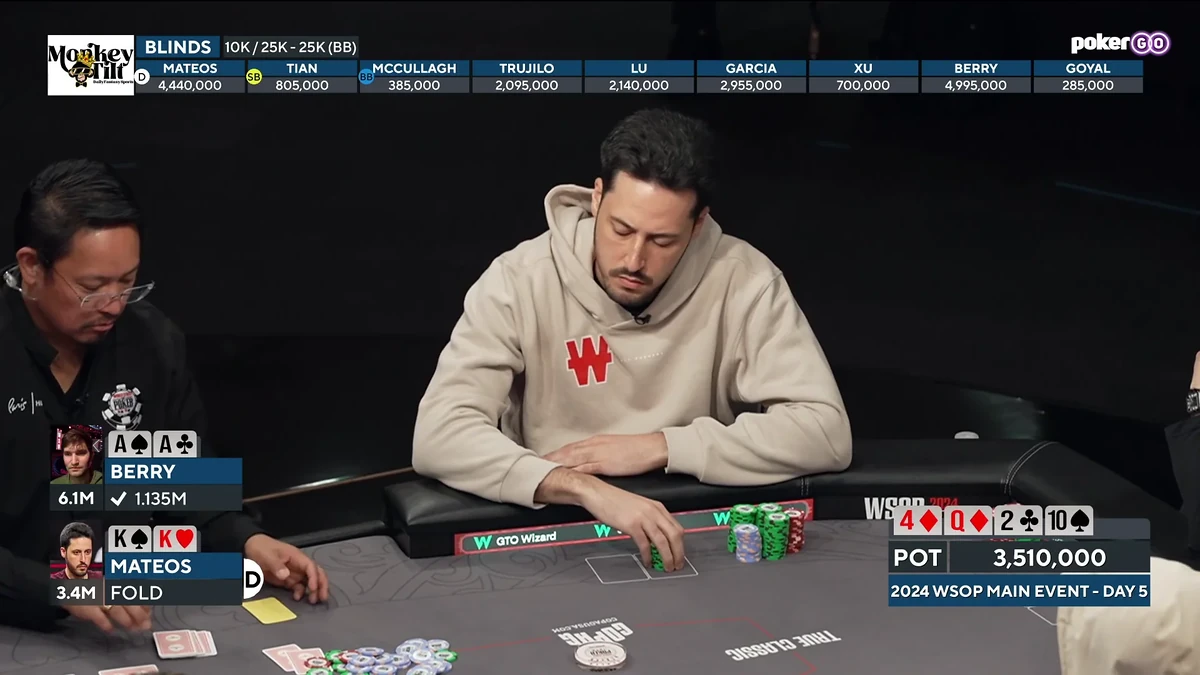
The hand came on Day 5 of the 2024 WSOP Main Event, on the PokerGO feature table. In a four-bet pot, Will Berry led out from the hijack on a :4d: :qd: :2c: flop for 425,000 into 1,360,000, and Mateos called on the button.
The turn was the :10s:. Berry bet 1,300,000 into 2,210,000, Mateos thought it over and folded :ks: :kh: face up, and Berry showed :as: :ac:.
| Street | Board | Berry (hijack) | Mateos (button) | Pot before the action |
|---|---|---|---|---|
| Preflop | Four-bet | Call | ||
| Flop | :4d: :qd: :2c: | Bet 425,000 | Call | 1,360,000 |
| Turn | :10s: | Bet 1,300,000 | Fold | 2,210,000 |
| Showdown | :as: :ac: | :ks: :kh:, folded face up |
His read was built before any card came. “Chip leader against second chip leader, probably his first TV appearance ever, and he will four-bet out of position against me playing 150 big blinds,” he said.
The sizing was bigger than he expected from a player unsure of the spot, and he picked up what he described as physical tells of confidence.
“For me, all these things said that he will have aces 90% of the time,” he said. “If you put in the equation that 90% of his range is aces, then you have to fold the turn.”
- His opponent’s first televised appearance, as far as Mateos could tell
- A four-bet out of position against the other big stack at 150 big blinds
- Bet sizes larger than the spot called for
- Physical tells he read as confidence
- Bluffs that are mixed in this spot, never pure, so a player who leaks them is left with value only
That last point is the hinge. If the bluffs are leaked, the four-bet range is value, and the value crushes kings. It was not a 100% fold either: “I may be folding 70% of my range, not 100%, so still some hands to defend against a really tight range.”
Why He Still Calls It a Blunder
He never argued the fold was correct in theory. “I know that folding kings is a big, big blunder and a big, big mistake,” he said, “but I think this is how poker works, and the good players need to be brave to do this.”
Being wrong sometimes is priced in, and he added that big exploits also open the door to being exploited back.
The reward lasted minutes. His aces were cracked by Adrian Garcia’s ace-king running out a flush, a sequence covered in the hands that defined poker in 2024, and he was out before the day ended.
Six Pros & Two VIPs: How He Reads a Triton Table
Rolle raised the published lists that show familiar pros deep in the red at Triton, and Mateos was not surprised. “I know my business,” he said. The samples are 100 to 200 tournaments, and at those stakes a few winners take a lot while many losers give back a little.
His count of a table: “On average it will be like six pros plus two VIPs, more or less, or one and a half VIPs.” That is a good ratio for the stakes, and it still leaves a hard rule for anyone sitting down.
- Six pros at a typical Triton table
- Between one and a half and two VIPs
- Be one of the top two or three players at that table, or variance owns your results
“To be a big winner at Triton you need to be top two, minimum top three at your table most of the time,” he said. “If you are not, then variance is huge for you.”
Many of the names on every Triton winner and payout in 2026 are, by his reckoning, break-even players or small losers. He put the spread in ROI terms: some pros win at 20%, others at 1% or 2%, and that gap is the whole story of who keeps the money.
How He Knows He Beats the Games
Asked how he knows he beats the games, Mateos pointed online. The $5,000 and $10,000 online tournaments are tougher and lower-ROI than live super high rollers, he said, so a strong online win rate tells him he is winning live, “especially after 15 years of experience.”
| Test | Mateos | Rolle |
|---|---|---|
| Benchmark | Online win rate in $5K and $10K tournaments | Feedback from a winning coach, forums and two or three friends |
| Window | Six to twelve months of results | Until the feedback matches the results |
| Move up when | The win rate and the bankroll both allow it | A winning coach tells him he is ready |
| Hold or move down when | A downswing starts eating buy-ins | Hand reviews keep coming back mostly negative |
For a $5 or $10 player he gave the same answer: “Focus on the data that you get when you play online.”
Mateos studies most with Juan Pardo and João Vieira, and he named the same two as the opponents he finds hardest, because they know exactly how he thinks. “It’s a lot of levelling war,” he said.
Why He Will Not Play PLO
The same honesty keeps him out of pot-limit Omaha. He will not pretend a few months of study would beat players with ten years in a second game: “If you compete at the highest level and you are not prepared, reality will slap you in the face pretty fast.”
Rolle’s Four Forced Choices & Mateos’s Answers
Rolle closed with a game he calls Raise Your EV, already played with Triton and WSOP regular Stephen Chidwick. Both options are bad and the guest picks the less bad one.
| Scenario | The choice | His pick | His reason |
|---|---|---|---|
| Aces, first hand of the WSOP Main Event, 300 big blinds deep | Open-limp or open-shove | Limp | “I don’t think many people will call kings” |
| Defending the big blind | Call only with 100% of hands, or three-bet only | Call only | Three-bet only plays about 25% of hands and loses more EV |
| Opening ranges | 100% from middle position or 50% from under the gun | Middle position | “Pretty close”, but you can fold to a raise in front of you |
| Postflop | Min-raise preflop but never bet over a third of pot, or open-limp with any sizing | Limp | “The biggest EV of your hand normally comes from postflop” |
His fourth answer carries his wider point: “Preflop and flop mistakes are really small, EV-wise. The key moment when you win the EV is turn and river.”
Rolle changed his mind on the first question: he had told Chidwick he would shove to get called by kings, then agreed the money goes in anyway when someone has kings behind a limp.
From the 2018 Downswing to the Best Year of His Career
Mateos won the WSOP Europe Main Event at 19 in 2013 and was the 2017 GPI Player of the Year, with 20 weeks at number one from November 2017 to April 2018. Then came what he calls his biggest downswing.
“I relaxed myself too much. I stopped studying,” he said. He had staked players, invested in businesses and taken on responsibility for “many people”, and said the losses came more from those than from the tables.
The fix was subtraction. He dropped everything except no-limit hold’em tournaments, and he credits that decision for what he told Rolle are the best years of his career, a run that includes his sixth bracelet in the $250K Super High Roller.
Those three results sit on top of what had been his best year by earnings, the $13.1 million he won live in 2024, the most won by any player that year, and he said keeping his place at the top is now the motivation.
Next is Triton North Cyprus, where Triton ONE runs from 5 to 15 November at the Merit Royal Diamond in Kyrenia and the Super High Roller Series follows until 30 November, then WSOP Paradise. The Cyprus results will land on the latest poker news and results as the series runs.
FAQs
Why did Adrian Mateos fold pocket kings at the WSOP Main Event?
He read Will Berry’s four-bet out of position, the large bet sizes and confident physical tells as aces about 90% of the time, and he says the bluffs in that spot are mixed, never pure. He called the fold a theoretical blunder he was willing to make, and Berry showed aces.
Does Adrian Mateos play GTO?
No. He uses theory as a baseline and says copying solver outputs is a big mistake, because a solver fed the wrong ranges returns the wrong answer. He also rejects random exploits made without knowing the baseline frequency.
What is Adrian Mateos playing next?
Triton North Cyprus, with Triton ONE from 5 to 15 November 2026 and the Super High Roller Series from 15 to 30 November, followed by WSOP Paradise in the Bahamas.
Der Beitrag Adrian Mateos on GTO: Copying the Solver Is a Mistake erschien zuerst auf VIP-Grinders.
About The Author