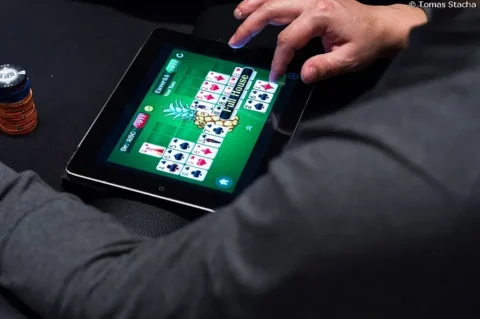
Short-deck poker strategy starts with the math: six-plus Hold‘Em removes 2 through 5, cutting starting-hand combos from 1,326 to 630 and reshaping equity, draw odds, and short-stack pressure.
If you are wondering what short-deck poker is, it is short-deck Hold‘Em played in an ante-led structure where collisions happen sooner, and hand rankings can change by room rules.
This guide gives the rules of short-deck poker, short-deck poker hand rankings, and the exact probability shifts that change decisions.
Short-Deck Poker Explained for Modern Hold‘Em Play
Short-deck poker, also called six-plus Hold‘Em, uses a 36-card deck and an ante-led structure that forces earlier, higher-frequency all-in decisions.
What Is Short-Deck Poker and Why the Deck Shrinks
Understanding what is short-deck poker becomes clear once the card removal is quantified.
Cards 2 through 5 are removed from each suit, reducing the deck from 52 cards to 36. That change cuts the total number of possible starting hand combinations from 1,326 to 630, a reduction of more than 52 percent. Premium holdings appear more frequently as a direct result.
Pocket Ace combinations rise from roughly 0.45 percent in standard Hold‘Em to about 0.83 percent in short-deck Hold‘Em, meaning players see top pairs almost twice as often over equivalent hand volumes.
This compression alters preflop equity relationships; in a standard game, Ace King offsuit holds approximately 65 percent equity against a random hand. In short-deck poker, that edge narrows to roughly 58 percent because more connected high cards remain in play.
The practical outcome is fewer uncontested pots and more multi-street confrontations where marginal equity edges must be monetized through betting, rather than card dominance. That dynamic is why six-plus appears in high-stakes cash rooms and major tournament stops.
Why Action Accelerates in Six-Plus Hold‘Em Games
Straights and sets occur more often, forcing larger bet sizes to deny equity.
A typical example involves a hand such as Ace King of spades on a King Queen 9 flop. In standard Hold‘Em, only eight cards complete a straight. In short-deck poker, ten cards do so because the 10 remains, while lower blockers are absent. That increase lifts straight completion probability on the turn from about 17 percent to nearly 28 percent.
This mathematical pressure rewards decisive play. Passive lines allow opponents to realize equity too cheaply, particularly in ante-based structures where pots are already inflated before the flop.
As noted in GTO Wizard’s analysis of short-stacked decision-making, “As long as you have one chip, you’re in contention. Each chip you add to your stack after that is worth less than the ones you already had.”
The same principle applies to short-deck poker, where chip utility declines rapidly as stacks collide more frequently under compressed odds. On pages like the best poker bonuses, short-deck’s hand volume amplifies variance.
Rules and Table Flow in Short-Deck Hold‘Em
The rules of short-deck poker mirror Hold‘Em, but antes, ranking variants and operator settings reshape every betting round.
For baseline rules and ranking variants, cite the Official Game Rules Short Deck Hold‘Em summary, then cross-check operator-specific settings before the first hand.
How Short-Deck Poker Rules Shape Each Hand
Short-deck poker rules typically rely on a mandatory ante posted by every player, sometimes paired with a single button blind. With antes plus a button blind, the preflop pot is large relative to stack depth, which increases raise frequency and lowers the threshold for profitable jams.
For instance, in a six-handed game with a one-chip ante and a two-chip button blind, the pot starts at eight chips, which is a built-in four big blinds if you define the button blind as two chips.
Community cards follow the same sequence as traditional Hold‘Em, yet the Ace carries expanded value. The Ace plays high as normal and can also play low, only to make A-6-7-8-9, which is the lowest straight in short-deck. Official Game Rules state the A-6-7-8-9 straight, but you still confirm it per room.
Such an adjustment increases straight density across flops and turns. In numeric terms, the probability of flopping any straight rises from roughly 0.39 percent in standard Hold‘Em to about 1.62 percent in short-deck poker, a fourfold increase that directly affects continuation betting frequencies and sizing decisions.
Operator Variations and Rule Interpretations
Not all short-deck Hold‘Em games operate identically. At Triton Poker Series events, a flush outranks a full house, reflecting the reduced availability of suited cards. This ranking is also shown in widely used short-deck rule summaries and is presented as a standard Six Plus variant in multiple operator guides.
Many online rooms offering short-deck formats rank full houses above flushes, aligning more closely with traditional expectations. That distinction carries meaningful equity consequences.
In flush-over-full-house environments, the number of flush combinations drops to 1,280 from 5,108 in standard Hold‘Em, while full house combinations remain relatively stable due to higher paired board frequency.
Within popular online poker sites, rule disclosures typically appear within table settings and should be reviewed before play.
A flush draw with two streets to come may warrant aggressive semi-bluffing in one environment and controlled pot building in another. Understanding these operator-level nuances transforms how to play short-deck poker efficiently while reducing avoidable misreads tied to assumed rankings.
Short-Deck Poker Hand Rankings and Probability Shifts
Short-deck poker hand rankings depart from tradition because the underlying math no longer supports full-deck assumptions. With fewer low cards, certain made hands occur at rates that force reordering, directly affecting equity realization and showdown expectations.
How Reduced Cards Reorder Hand Strength
Short-deck poker hand rankings elevate straights and sets due to combinatorial scarcity elsewhere. Removing 2 through 5 eliminates 16 cards that would normally block straight construction, leaving more connected high-card sequences.
As a result, straights appear more often than three of a kind in many simulations, reversing the hierarchy used in standard Hold‘Em.
Flush frequency drops sharply because each suit contains nine cards, rather than thirteen. That reduction cuts total flush combinations by roughly 75 percent. For decision-making, this means that a completed flush on the river often represents the effective nuts, while full houses require contextual evaluation, not automatic stack commitment.
Hand Frequency Comparison Table
The table below summarizes the most important frequency shifts.
| Hand Type | Full Deck Approx. | Short Deck Approx. | Why It Matters |
| Flop Straight | ~0.39% | ~1.62% | More pressure on turns |
| Any Flush By River | Higher | Much Lower | Nine cards per suit |
| Full House By River | Lower | Higher | Paired boards happen more |
| Trips vs Straight | Straight Higher | Trips Higher | In many rule sets |
Official Game Rules lists the common ranking switch where a flush beats a full house and trips beats a straight, but some rooms run traditional rankings. Confirm the ranking on the table rules screen before you assign “nuts” status to a river flush.
In a six-player short-deck game, the probability of at least one straight appearing by the river exceeds 32 percent, compared to about 18 percent in full-deck Hold‘Em. That difference alters river betting incentives and bluff-catching thresholds.
Calling ranges widen against polarized bets in ante-heavy structures, especially when playing on offshore platforms.
Strategic Pressure Points In Short-Deck Poker Play
Short-deck poker strategy flows from compressed equity and elevated collision rates, rather than from deep-stack patience. Decisions gain value through timing and sizing, since small edges recur more often across fewer cards.
Why Equity Runs Closer and Aggression Scales Faster
In short-deck poker, starting hand equities converge tightly.
A hand such as Ace Queen suited holds about 57 percent equity against King Queen suited preflop, compared with roughly 62 percent in standard Hold‘Em. As another benchmark, KK is only about a 53 percent favorite versus AK suited in short-deck, which shows how quickly premiums lose separation.
That narrowing reduces the protective value of premium holdings and raises the importance of initiative. Betting first captures fold equity in spots where raw hand strength alone no longer dominates.
A worked example is as follows: consider six-handed, one-chip ante, two-chip button blind and you are on the button with 20 chips. The pot is eight chips preflop, so if you shove 20 and get called by one player, your shove risks 20 to win 28; you need about 41.7 percent equity when called to break even before fold equity.
That break-even threshold is why short-deck poker strategy pushes earlier all-ins and wider value ranges than full-deck cash games.
Many short-deck structures use antes plus a button blind, including the “double ante on the button” format popularized in Triton-era games. That structure inflates SPR faster, which makes preflop and flop aggression the default rather than the exception.
A 2025 study titled “The Importance of Emotional Control for the Professional Poker Player” links emotional regulation to fewer variance-driven errors in repeated high-pressure decisions.
Tactical Adjustments That Define Winning Short-Deck Play
Drawing hands gain leverage in short-deck poker strategy because completion probabilities rise sharply. An open-ended straight draw on the flop completes by the river nearly 45 percent of the time, compared with about 32 percent in standard Hold‘Em.
Because your draw completes almost half the time by the river, you size to deny correct calls, not to “see what happens,” and you favor shove-friendly lines when SPR is low.
| Strategic Factor | Standard Hold‘Em | Short-Deck Hold‘Em |
| AA Frequency | ~0.45% of hands | ~0.83% of hands |
| OESD River Completion | ~32% by river | ~45% by river |
| Flop Any Straight | ~0.39% | ~1.62% |
Traditional patience-based models underperform, including on real money gambling sites. Successful adaptation comes from recalibrating expectations, sizing bets to deny equity and accepting variance as a structural feature rather than a flaw.
Are You Ready to Play Short-Deck Poker?
Short-deck poker rules change the entire value map: equities run closer, the pot starts bigger and short-deck poker hand rankings can differ by operator.
If you are learning how to play short-deck poker, you win faster by treating SPR as the governor, building ranges around higher draw completion and confirming whether flush beats full house.
Short-deck poker strategy is not “looser poker,” it is math-driven aggression with disciplined calls.
Please play responsibly. 21+, T&Cs apply.
About The Author