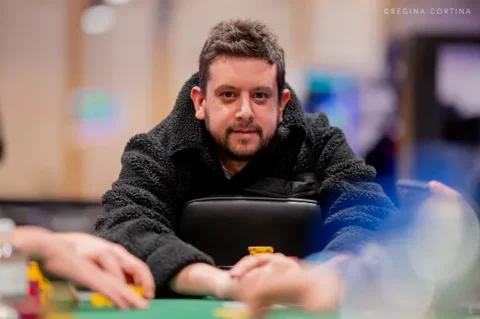
The first of a series of one-day tournaments is in the books at the 2026 PokerGO Cup. These tournaments reflect a change in the PGT’s format, which usually sees a two-day tournament rather than cramming it into one day of action. It didn’t seem to keep the players away, however, as they played into Thursday morning to determine a champion.
Logic Behind the Move?
The PGT’s move to force these players to play a champion in one day is questionable at best. They started on Wednesday at noon (Pacific Time), and perhaps the PGT thought they would not get the numbers that they did. In the end, Event #2 on the 2026 PokerGO Cup schedule saw a throng of players flood the PokerGO Studios at ARIA in Las Vegas.
By the time late registration concluded, 111 entries had been collected, building a prize pool of $555,000. Event #2 featured several PGT regulars, including Andrew Lichtenberger, David Coleman, Jim Collopy, and Joao Simao. It would only take two hands before someone was eliminated, Dan Sepiol, and he immediately spiked another $5K on the table to reenter the fray.
The one-day nature of the tournament meant that the blinds were almost turbo-like. Only 25 minutes per level was the standard, and the action zipped along fairly well. One thing that didn’t happen? Players busting out, as they protected their chip stacks with a vehemence that you normally do not see in a re-entry tournament. Late in the evening, 27 players were still left, and it was apparent the tournament would go way into the night.
While an interesting test for the “high rollers,” some might question why they want to put this level of player through such a crapshoot of a tournament. Lower-stakes players are quite used to having to deal with rapid structures that eat into a stack quickly. The PGT, however, is supposed to be where players demonstrate poker skills, rather than their ability to gamble. There are still a couple more of these “one day” tournaments left, so the experiment isn’t over…yet.
Hand-for-Hand at Midnight?
It didn’t quite reach midnight before the money bubble popped, but it was pretty damn close. Just after 11 PM, David Kim used A-J to out-flop John Riordan’s pocket Kings to send Riordan to the rail with nothing to show for his efforts. As Riordan packed his bag, the other 16 players celebrated having picked up some cash for their efforts.
Sepiol made the most of his rebuy, knocking Manig Loeser out in 16th place ($8,325), and the floodgates opened for eliminations. Loeser was followed by Chris Hunichen, Clemen Deng, Landon Tice, and Sam Soverel, who departed with varying amounts of cash from the prize pool. Sepiol’s second bullet would run out just short of the official final table, as Nicolas Seward’s A-10 cruelly outdrew Sepiol (A-K) on a 10-A-Q-4-5 runout.
That hand was enough for Seward to take the chip lead among the final seven players, but fatigue had to be setting in on the players. The final table was not determined until roughly 1 AM, and only Seward (3.3 million, 66 big blinds), Drake Kemper (three million, 60), and David Kim (2.6 million, 52) could be said to have viable stacks for battle. It left players such as Jesse Lonis (1.6 million, 32), Jon-Michael Gisler (1.3 million, 26), Dylan Linde, and Filipp Kavin (both 900,000, 18) having to make moves given the rapid nature of the tournament.
Kemper busted Linde in seventh to end his night, but Kavin doubled through Kemper to get healthy in the early action. The other short stack, Gisler, also showed some resiliency as the cards worked in his favor in rivering an Ace to top Lonis’ pocket Jacks in an all-in situation. The short stacks’ ability to survive kept the tournament running into the early morning hours.
It was a clash between the big stacks at the table that saw the first momentous change. Seward pushed all-in pre-flop, only to be met by Kemper in the small blind. The cards were turned up:
Kemper (small blind): A-Q
Seward (button): pocket eights
Seward was running well through the ten high flop, but the Queen on the turn changed the fortunes of the two men. Once an eight failed to come on the river, Seward was out of the tournament in sixth place, and Kemper assumed the lead.
As the blinds climbed, the pushes became more frequent. Kemper’s big stack became a gone stack after first Kim and then Lonis devastated it, sending Kemper home in third place. As the clock ticked closer to the morning light, Lonis and Kavin, with nearly equal stacks, negotiated a deal that saw them split the remaining money according to ICM standards. They left $20K up for grabs, along with the PGT PokerGO trophy, which was determined rather quickly.
On the first hand of heads-up play, Lonis pushed all-in with an A-6, and Kavin called off with a lesser K-10. It was less until the flop, that is, a 4-K-6 flop hit Kavin hard, putting him in the lead, and the nine on the turn and Queen on the river did nothing to change the situation. Kavin scooped the pot, and Lonis, with only 500K left in front of him, sent those chips to Kavin after another Ace, this time A-9, failed to connect against Kavin’s 10-6 on the Q-10-Q-K-4 board to end the tournament at roughly 4 AM Thursday.
1. Filipp Kavin, $124,525*
2. Jesse Lonis, $105,800*
3. Drake Kemper, $63,825
4. David Kim, $49,950
5. Jon-Michael Gisler, $36,075
6. Nicholas Seward, $27,750
7. Dylan Linde, $22,200
(* – reflects deal during heads-up play)
On Thursday and Friday, there will be two more of these “one-day” tournaments, and it will be a good question to see if the players subject themselves to this style of event. On March 9, the first of the $10K tournaments begins, the traditional two-day affair that the PGT has, and there will be five more $10K tournaments after that. It’s all for the glory of the 2026 PokerGO Cup, one of the marquee tournaments on the PGT schedule.
(Photo provided by PokerGO)
The post Series of One-Day Tournaments Continues 2026 PokerGO Cup Schedule appeared first on Poker News Daily.
About The Author