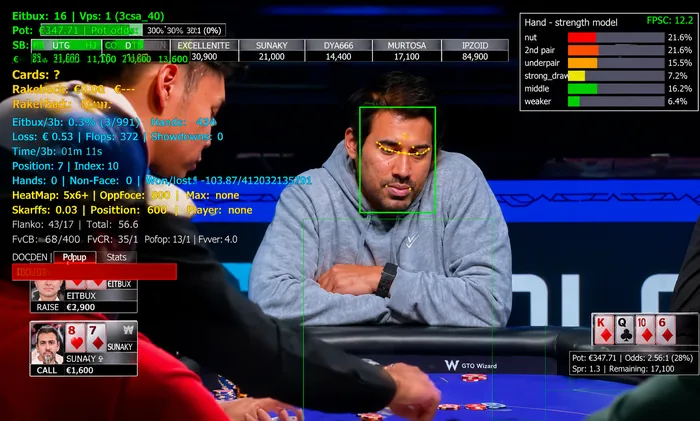
ESPN’s WSOP 2026 coverage includes an AI model that flags when a player is likely bluffing, or likely sitting on the nuts, by reading posture, blink rate and facial movement. It debuted as the WSOP returned to ESPN for the first time since 2020, produced by Peyton Manning’s Omaha Productions.
The tool never sees a hole card and is only used on players who have already been eliminated. Even so, it has split the poker world. Is this a clever broadcast upgrade, or the beginning of the end for the poker face?
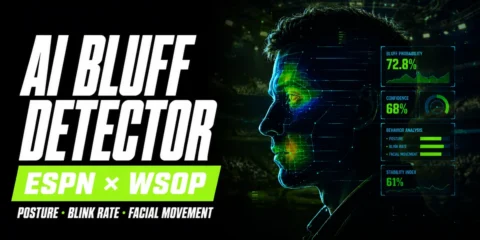
How the WSOP AI Bluff Detection Tool Works
The model is the work of Luke Geel, an independent AI engineer who spent around six months building it, a job he has admitted proved harder than he expected. It was trained on historical poker footage and past results, learning how visible behaviour lines up with hand strength.
The system spots patterns that mean nothing to the average viewer but plenty to top pros. It then estimates the probability that a player is bluffing or holding a premium hand. The feature was first reported by Sportico as the coverage launched in early July.
| Detail | Fact |
|---|---|
| Developer | Luke Geel, independent AI engineer |
| Development time | Around six months |
| Signals analysed | Posture, blink rate, facial movement |
| Trained on | Historical poker footage and results |
| Debut | WSOP 2026 Main Event coverage on ESPN |
The output is always a probability, never a verdict. The AI cannot prove a bluff; it can only say the body language looks like one.
Why the AI Only Reads Eliminated Players
Omaha Productions is deliberately cautious with its new toy. The AI segment is applied only to players who have already busted, so nobody still in contention can have their habits decoded on air.
- Eliminated players only: the model is never pointed at anyone still holding chips in the tournament.
- No card data: the AI works purely from behaviour and past results. It never sees a hole card.
- Delayed hole cards: the broadcast already shows viewers every hand on a security delay, so bluffs are never a mystery for long.
That last safeguard is where the criticism starts. Between delayed hole cards and the on-screen odds graphics, the modern broadcast already tells viewers nearly everything. The AI is not answering whether a bluff happened; it is showing what a player’s body was doing while it happened.
The feature is one piece of the multi-year ESPN broadcast deal that returned the series to mainstream American television. Full schedule details sit in our guide on where to watch the WSOP 2026.
Does AI Tell-Reading Damage the Game?
For many players, the objection is simple: televised poker works because of human tension. The Main Event’s drama comes from deception, composure and the occasional crack in both. Handing that reading job to a machine strikes critics as a gimmick nobody asked for.
The sharper worry is behavioural. Once players know a camera-fed model can decode their habits, the rational response is to train those habits away, or fake them on purpose. Surveillance changes behaviour, and in a game built on deception the watched player adapts fastest.
Reading opponents has always been a core poker skill, as any primer on how profitable bluffing actually works will confirm. The open question is whether that skill should stay human.
Omaha Productions sees it differently. ESPN was the channel where Chris Moneymaker’s 2003 Main Event win set off the poker boom, and the stated goal is putting poker back in front of that audience.
The AI segment is one of the hooks. Dan Gati, Omaha’s head of content, is confident about the product around it:
“Live poker is as popular as it has ever been.”
Dan Gati, Head of Content, Omaha Productions
The Poker Face May Not Be Safe Anywhere
Poker is only the latest testing ground for this kind of computer vision. The same idea is spreading through sport and business: cameras trained not on what people do, but on what they intend to do.
In football, researchers have built models that analyse a penalty taker’s run-up before the ball is struck, hunting for clues about where the shot will go.
David Freire-Obregón, an associate professor in Spain working on that research, doubts the machines will ever take over:
“I don’t think AI will ever make penalty shootouts predictable.”
David Freire-Obregón, Associate Professor
The same ceiling probably applies at the poker table. Prediction does not solve a game of deception; it moves the battleground. The moment the model becomes accurate, the behaviour it reads starts to change.
See It Live: ESPN Final Table, August 3 to 5
The tool’s biggest stage is still to come. The Main Event final table airs live across ESPN’s networks from August 3 to 5, with $10,000,000 waiting for the winner of the $10,000 buy-in world championship. Every elimination hands the AI a fresh subject on the year’s biggest poker broadcast.
Whether the feature returns in 2027 will depend on how this audition lands. Until then, the final nine and their body language are the test case, and you can follow every hand through our Main Event final table coverage.
Der Beitrag WSOP 2026 AI Bluff Detection: ESPN Tool Sparks Ethics Debate erschien zuerst auf VIP-Grinders.
About The Author