Doug Polk posted a short history of poker to his Facebook page this week. He splits it into three eras: the boom before Black Friday, a decade of American decline after it, and a resurgence over the last five years.

He credits that recovery in part to the rise of sweepstakes and crypto platforms. His verdict, in his own words in that post, was that this is “the best era of poker I can remember in 15 years”.
We publish monthly traffic figures for 36 poker networks, so this is a claim we can actually test rather than argue about. One of the two drivers he names is growing faster than anything else in the market. The other is going backwards.
He still lands on the right answer. What follows is the case for why, and the parts of his reasoning that do not survive contact with the numbers.
Crypto Yes, Sweepstakes No: Testing Polk’s Two Drivers
Polk names sweepstakes and crypto platforms in the same breath, as though they were two halves of the same recovery. In our monthly online poker traffic report for August 2026 they look nothing alike.
The Part He Got Right
CoinPoker averaged 2,016 concurrent cash game players in August 2026, third globally behind GGPoker and the PokerStars international pool. That is a bigger cash game than any room in Italy, any room in the regulated United States, and every sweepstakes product combined.
The trend matters more than the rank. CoinPoker is up 22.7% on the 90-day window, and it is the only network in the global top five that is positive over that period. GGPoker sits at -0.8%, PokerStars at -15.0%, Winamax at -12.6%.
Crypto is not a curiosity at the edge of the market any more. On the numbers it is the healthiest segment in poker, and Polk is right to name it. Our guide to the best crypto poker sites we tested covers the rooms behind that growth.
The Part He Got Wrong
The sweepstakes segment holds 501 concurrent cash game players across every tracked product. It fell 1.2% over the 30-day window in a month when 19 of the 28 networks reporting cash data grew.
Inside the segment the picture is worse. Stake.us Poker is negative across all three timeframes at -5.1%, -11.7% and -15.2%, one of only seven networks in the entire dataset falling on every window. Global Poker is down 25.1% on the 90-day.
One product is going the other way. Clubs Poker holds the strongest 90-day trend of any tracked network at +23.0%, which is a real result on a small base. It is not enough to lift a segment holding 501 seats against a global market of tens of thousands.
Worth holding onto the scale here before anyone declares a golden age. Every cash game seat tracked across all 28 reporting networks adds up to 21,784 players, and August was a growth month.

Stretch the window and the recovery looks thinner. Only six of those 28 networks sit above where they were 90 days earlier, which means most of the market bounced off a July floor without getting back to where it stood in May.
One disclosure belongs here. Polk sold Upswing Poker to the sweepstakes operator ClubWPT Gold in August 2025 and has been a ClubWPT Gold ambassador since April 2025.
He also co-owns the 68-table Lodge Card Club in Texas. All three are set out in full on Doug Polk’s career and business record.
Three Eras, Drawn From One Country
Look again at where Polk draws his lines. Black Friday, the American decade that followed, and a recovery he dates to players staying home during COVID. Every boundary is a United States event.
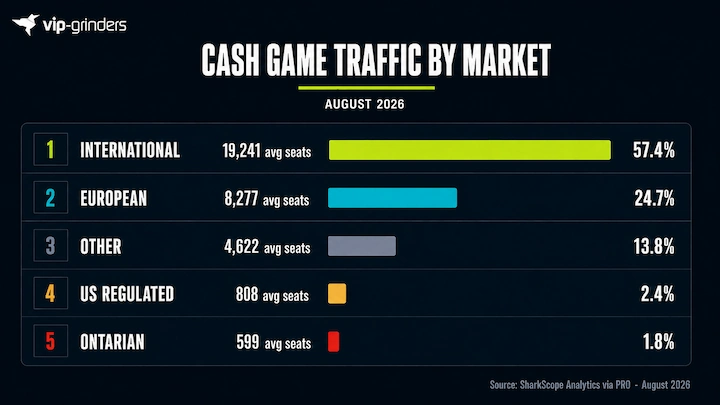
That is a reasonable lens for an American commentator and a poor one for describing a global game. The entire regulated US poker market is 2.4% of global cash game traffic, at 808 concurrent players across four operators.
It was also the steepest declining segment in the market in August 2026, down 5.2%.
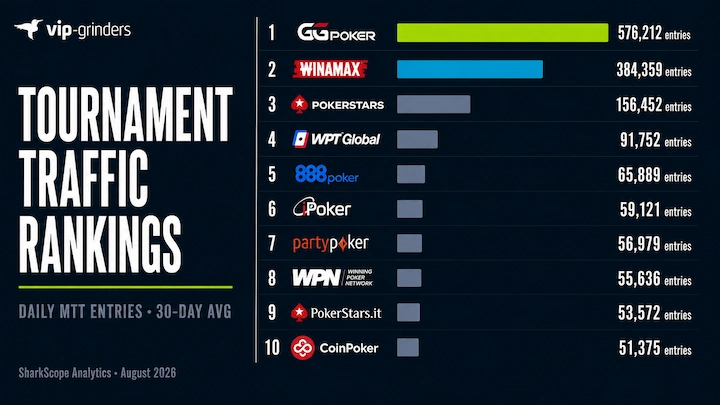
Ask a French or Spanish grinder to split the last twenty years and the lines land somewhere else entirely, at ring-fencing rather than at an American indictment. Winamax now generates 384,359 daily tournament entries from two countries, making it the second-largest tournament network on earth.
| Era | Years | What Defined It | What It Cost Players |
|---|---|---|---|
| The boom | 2003 to 2011 | Mass arrival of recreational players, no study tools | Nothing. This was the cheapest poker ever played |
| The American decade | 2011 to 2020 | US players locked out, liquidity fragmented by border | A generation of American professionals |
| The return of volume | 2020 to now | More schedules, more formats, crypto rails, solver-literate fields | The edge. Volume returned, the soft money did not |
There is a harder objection to the idea that players have more options than ever. India banned real-money gaming nationwide, removing one of the largest ring-fenced poker markets in the world and pushing its leading operator to a social model.
PokerStars withdrew from Poland, Latvia, Japan and Sri Lanka in 2025, costing roughly 7% of its international pool.
For a very large number of players, this era brought fewer places to play, not more. That does not make Polk wrong about the game he can see. It does mean the claim only holds from certain postcodes.
Era One Was Softer, Not Bigger
The boom is remembered as enormous, and the nostalgia usually attaches to size. Size was not what made it different.
What made 2003 to 2011 unlike anything since is that almost nobody had studied. Chris Moneymaker’s 2003 Main Event win brought in a wave of players who had learned the game from television, and the players already there were barely ahead of them.
Why 2003 to 2011 Felt Easy
- No solvers, and no consumer hardware capable of running one
- No course-based training sites and no serious video libraries
- Tracking software in its infancy, and most opponents had none
- Preflop ranges passed around as folklore rather than as charts
- Almost no player pool anywhere had been hardened by regular study
There is a less flattering explanation for the nostalgia too. Most people who describe the boom as poker’s golden age were in their early twenties when it happened. Some of what they miss is the poker and some of it is being 22.
What Black Friday Actually Cost
This is the era Polk describes most accurately, and the damage is still measurable. Fifteen years on, the great majority of Americans still have no licensed option at all.
The money did not disappear when the option did.
| What Black Friday Left Behind | Figure |
|---|---|
| US states with an operational regulated market | 6 |
| Americans with no licensed option | 88.6% |
| Annual US wagering with unregulated operators | $673.6 billion |
| Share of Americans using only legal sites, 2022 to 2025 | 52% down to 24% |
Those figures come from the American Gaming Association, published in August 2025. The legal-only share fell by more than half in three years.
The bookend arrived this April, when PokerStars left the US market voluntarily and folded into FanDuel’s platform. In 2011 prosecutors forced it out; this time it was a business decision. Our look at fifteen years on from Black Friday covers where American players actually ended up.
More Games Than at Any Point Since 2011
Here Polk is right, and the evidence is stronger than the version he offered. The 2026 World Series ran 100 bracelet events between 26 May and 15 July and drew 251,901 entries.
The Main Event, by contrast, was the fourth-largest in history at 9,208 entries, building an $85,634,400 prize pool. That is a very good year and nothing like a record.
Put those two facts together and the shape of modern poker appears. Seven events that summer drew bigger fields than the Main Event. The marquee grew modestly while the schedule underneath it swelled.
| Event | Buy-in | Entries |
|---|---|---|
| Mystery Millions | $1,000 | 22,811 |
| Mini Mystery Millions | $550 | 20,488 |
| Colossus | $500 | 16,269 |
| Mini Main Event | $1,000 | 12,560 |
| Monster Stack | $1,500 | 11,933 |
| Millionaire Maker | $1,500 | 11,769 |
| Gladiators of Poker | $300 | 11,185 |
| Main Event | $10,000 | 9,208 |
The same shape holds online, which matters because Polk was describing both. GGPoker alone took 576,212 tournament entries a day in August 2026, more than the next two networks combined.
The full breakdown of every bracelet won this summer shows the same pattern across the schedule. Growth is coming from the number of tournaments, not from the size of the famous one, and that is a genuinely good thing for anyone who wants to play.
Volume Is Not Value
This is where the argument needs a second half that Polk did not give it. More games is not the same as more money, and the two have been moving in opposite directions.
The Field Got Better and the Rake Did Not Move
Polk concedes that the average player is stronger now, then treats it as a fair trade against having more games available. It is not a trade a winning player would take without checking the price.
Roughly 30% of serious online players finish their careers in profit, rising to about 35% once a proper rakeback deal is factored in. Fields grew, study tools became universal and cheap, and the share of the pot taken off the table before anyone gets paid did not fall to compensate.
The mechanism is simple enough to state in a sentence. Rake is charged on the pot regardless of how well anyone at the table plays, so as the average opponent improves, the same fixed cost eats a larger share of a shrinking edge.
That gap matters more than it looks. The five points between those two numbers are not a bonus on top of a winning game; for many players they are the whole difference between winning and losing.
Our guide to whether online poker is still profitable works through what separates the two groups.
The Guaranteed Return Is Being Priced
The clearest signal of where this era is heading came from the room with the fastest growth in it. CoinPoker retired a 33% guaranteed rakeback rate on 1 April 2026, replacing it with an automatic rewards programme paid through leaderboards, splash pots and missions.
On 17 August 2026 it launched a paid monthly membership that returns a guaranteed 10% of rake, rising to 15% under certain conditions. A guaranteed personal rate now exists at that room only as a product you buy.
Read that as a market signal rather than a verdict on one operator. It is the first time a major room has treated a fixed return as a product to be sold rather than a term to be offered.
It is unlikely to be the last. We covered what the 3-Bet Club actually returns in detail.
The Fourth Era Nobody Has Named Yet
Polk’s history stops at COVID, which leaves out the change most likely to define what comes next. Artificial intelligence is not approaching the poker table. It is already sitting at one.
In March 2026 ACR Poker launched Skip-It MTTs. Each entrant is represented by five AI racers that play the opening phase autonomously, and no human touches a card until it is over.
- Race phase: AI racers play, under five minutes, roughly 80% of the field eliminated
- Manual phase: surviving stacks combine and the humans take over
- Day 2: a conventional tournament, played from in the money
Set aside whether it is a good format. AI playing real hands for real money on behalf of human entrants has no direct precedent in the game, and it shipped as a product rather than a proposal.
Our breakdown of ACR’s Skip-It MTTs and their AI racers covers how the phases work.
Whatever the fourth era turns out to be, it will be drawn around this rather than around the next piece of legislation. Polk’s three boundaries were all things done to poker by governments. The next one is being built by the industry itself.
Is This the Best Era of Poker?
On opportunity, yes, and it is not close. There are more tournaments, more formats, more guarantees and more places to find a game than at any point since 2011, and the crypto rails have made moving money easier than it has been in fifteen years.
On edge, no. The boom was a period when being slightly better than the table was enough, and no amount of schedule growth brings that back. What changed is not how good you have to be but where the advantage now comes from.
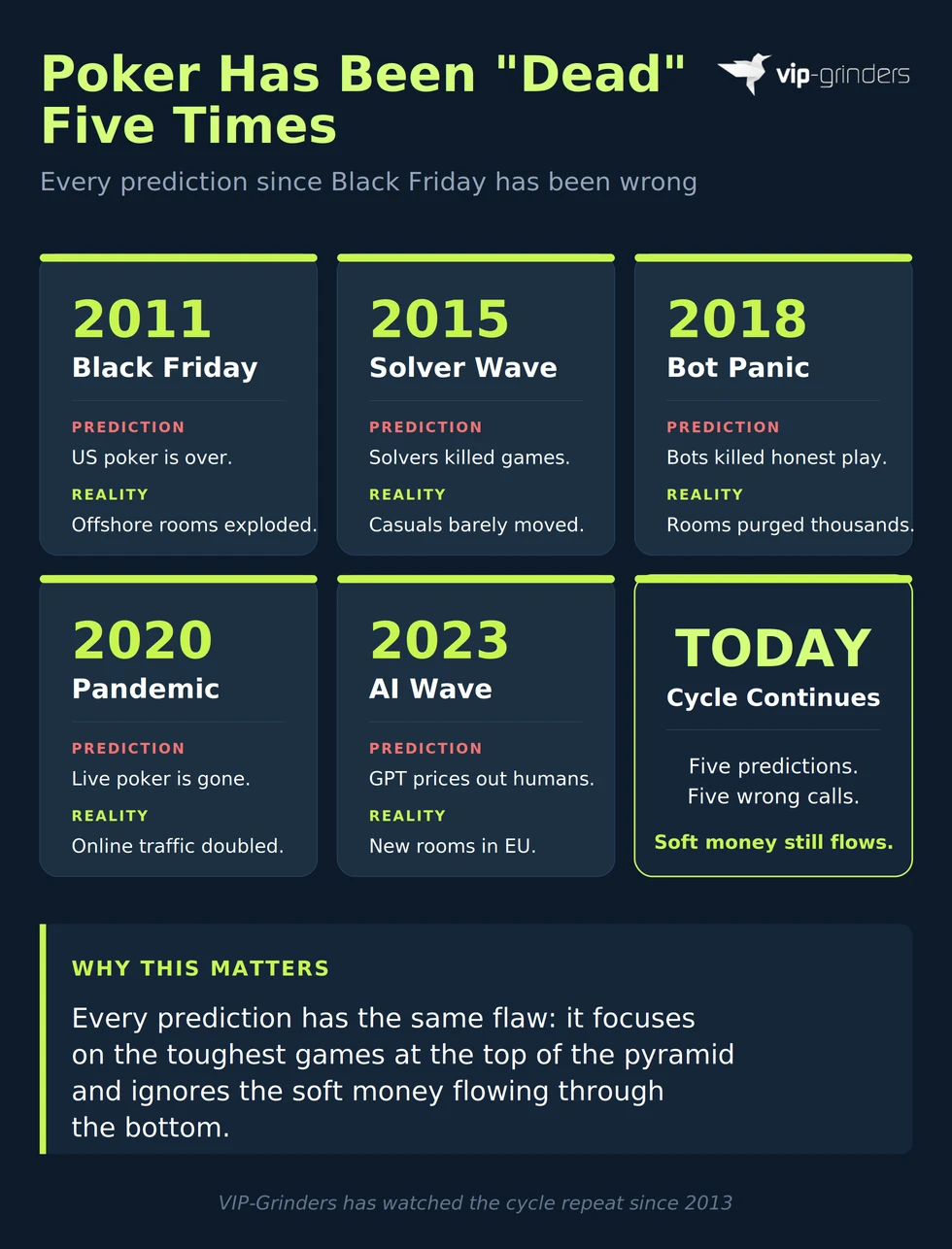
The nostalgia is durable in a way the evidence never supports. We have watched five separate waves of “online poker is dead” predictions since launching in 2013, recurring in 2015, 2018, 2020 and 2023. All five were wrong.
The best era of poker for a player who studies, chooses games carefully and understands what they are being paid back is right now. For anyone hoping to sit down and be the smartest person at the table by default, it ended around 2011 and it is not returning.
Polk is right that this is a good time to be playing, though not for the reason he gives. Poker got bigger while getting harder.
This era belongs to the players who profit from the first half without being buried by the second. Whether that balance holds is the story of the next five years.
Der Beitrag Is This the Best Era of Poker? Doug Polk Says Yes, and Our Own Data Says He Is Half Right erschien zuerst auf VIP-Grinders.
About The Author