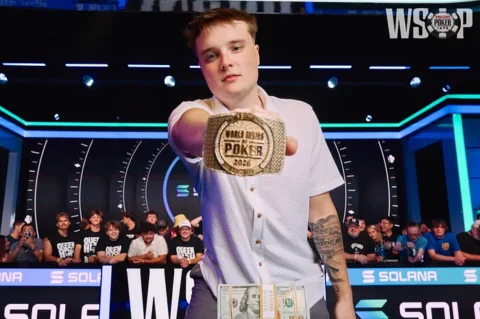
Pot Limit Omaha is currently considered the second-most popular variant of poker, trailing only No Limit Texas Hold’em. The 2026 WSOP featured 13 PLO tournaments, including two new additions such as Event #92, “Pick Your PLO”. One of these, the $100K PLO High Roller (Event #76), was won by Daniel Negreanu, who took home $2.2 million and his eighth career bracelet. Thousands of people watched his victory via live stream, with many discovering PLO for the first time.
The PLO tournaments at the 2026 WSOP were highly successful. Event #6 drew 2,636 entries at a $600 buy-in entry point; Event #35 saw 2,581 entries at $1.5K; and Event #57 recorded 3,763 entries at $1K. The PLO tournament with the highest number of entries was the $1K Mystery Bounty (Event #87), which attracted 4,764 entries — the second-largest field in history. The current record is held by the 2025 edition of the same tournament, which drew 5,284 entries.
In addition to the WSOP, PLO tournaments are also featured on the Triton Poker circuit, the PokerGO Tour (which even has an exclusive PLO festival), the WPT World Championship series, the BSOP, the PartyPoker Tour, and several other tours. Furthermore, televised PLO cash games — such as those on “Hustler Casino Live” — have emerged, further fueling the growing popularity of the format.
That is why we’ve created this guide for those with experience in No Limit Hold’em who are looking to take their first steps into Pot Limit Omaha. We will begin by covering the basic rules, followed by tips from professional players, advice on how to study the game, and finally, information on where you can play in PLO tournaments.

Basic Rules of Pot Limit Omaha
Pot Limit Omaha follows the same gameplay structure as No Limit Hold’em, with three key differences:
- Each player receives 4 hole cards instead of 2.
- Each player must use exactly 2 of their hole cards in combination with 3 of the community cards.
- The maximum bet or raise that can be made is equal to the size of the pot.
Let’s look at an example that shows how much you can bet pre-flop. Suppose you are playing a PLO tournament and the blinds are 100/200. You are in the UTG position and want to make a raise. To calculate the raise amount, you must add the current size of the pot (300), the last outstanding bet (200), and the amount required to call the previous bet (200), which gives a total of 700. If another player wants to re-raise, they must apply the same rule by adding 1,000 (the current pot) + 700 + 700, which results in 2,400.
Now, let’s look at an example of post-flop betting in a tournament. After raising from UTG and getting a call from a single opponent on the button, the pot stands at 1,700. Consequently, the player in UTG can bet a maximum of 1,700. Suppose the UTG player bets 1,700, bringing the pot to 3,400. If the player on the button wishes to raise by the maximum amount, the calculation would be 3,400 (the size of the pot) + 1,700 + 1,700, for a total of 6,800.
In PLO tournaments and cash games, beginners can ask the dealer for help if they are unsure about how much to bet or raise. They can also simply say “pot” when they wish to bet or raise, and the dealer will inform them of the correct amount. In online games, there is a “pot-raise” button that players can click.

PLO Tips from Professional Players
We reached out to several well-known players on the circuit who have had success in PLO tournaments and asked them the following questions:
- What advice would you give to someone looking to learn PLO?
- What adjustments need to be made regarding NLH?
- What are the most common mistakes inexperienced PLO players tend to make?
These were their answers:
Nacho Barbero (Two Triton Poker PLO titles)
- My first piece of advice would be that you learn PLO by playing; beyond studying the theory, you need a lot of practice. In Hold’em, there are many spots where you have to call 100% of the time, but in PLO, you will often hold the “second nuts,” and recognizing when its appropriate to fold only comes with experience.
- Several adjustments need to be made. While limping is rarely used in Hold’em tournaments, it is common in PLO. It is also necessary to try to play hands that can dominate your opponents’ hands. Furthermore, you should avoid playing large pots with hands that aren’t strong enough. For instance, if you make a pot-sized bet with K-K-x-x and your opponent responds with a pot-sized reraise, it is highly likely they hold A-A-x-x. Consequently, you will have to fold pre-flop quite often to avoid becoming pot-committed when you only have a 30% chance of winning the hand.
- I think the most common mistake is playing weak hands and chasing poor draws all the way to the river; ideally, you want to chase draws that are the nuts. You have to be very careful with hands you limp-raise, as they can cause problems post-flop.

Photo credit: PokerGO
Lautaro Guerra (Holds titles from the WSOP, Triton Poker, and PGT PLO Series)
- You should start by studying pre-flop play, since that is where almost all PLO errors originate. Play for low stakes initially, put in plenty of volume, and review your hands. Nowadays, with PLO solvers, the player who studies quickly pulls ahead of the one who simply plays.
- In PLO, equities run very close, and you are almost never a huge favorite. Position is extremely valuable, and pocket aces — without strong supporting cards after the flop — are just an average hand. Players coming from NLH take time to grasp this concept.
- Some of the mistakes include playing “pretty” four-card hands that don’t connect well, falling in love with A-A-x-x, and — the costliest one — calling bets on draws that aren’t to the nuts. Off the table, the mistake is underestimating variance in PLO, as the game requires a larger bankroll and a stronger stomach.

Photo credit: Regina Cortina
Pablo Panetta (3 PLO tournament titles in Brazil)
- My advice would be to focus primarily on studying game strategy and hand ranges — specifically open-raise, c-bet, and 3-bet ranges. I usually study on my own, and I really liked Fernando “JNandez” Habegger‘s content; he has a training site called PLO Mastermind where you can learn a lot.
- I think the main adjustment relates to blockers. In Hold’em, there is a tendency to bluff quite a bit without blockers, considering the opponent’s ranges. In PLO, however, we need at least one blocker when bluffing — and also when making a hero call — since the likelihood of it being the correct play is higher.
- The most common mistake is failing to properly understand hand ranges. Players often call 3-bets or play large pots with hands they shouldn’t be playing, potentially becoming pot-committed with an inferior or dominated hand. Certain hands — such as low flushes or straights — are also frequently overrated, as their strength differs between NLH and PLO.

Photo credit: BSOP
Felipe Campins (Made Final Tables at BSOP and Wynn Summer Classic PLO tournaments)
- To start off, I think it is crucial to fundamentally understand what variance means — not just at a superficial level, like a dictionary definition, but in its entirety. Equities run much closer together than in NLH, which means losing many more pots even when holding the “nuts” formed on earlier streets (pre-flop, flop, or turn). Naturally, this brings frustration and psychological challenges. Quantifying the weight and importance of variance can help alleviate some of the self-imposed pressure to achieve quick results. Moving on to the technical side, the best advice I can give is simply to play; trial and error is the best way to learn. You should play with the specific goal of understanding what is happening and why certain decisions yield better outcomes than others amidst the vast array of possibilities. Ultimately, both NLH and PLO are disciplines rooted in data and variable analysis, pattern recognition, and execution under pressure. While those fundamentals remain the same, strategy construction differs significantly. PLO requires far greater adaptability. You must understand that the “nut advantage” often shifts with every street, meaning frequencies and bet sizes must adjust accordingly. Building a solid pre-flop range is just as vital in PLO as it is in NLH. This is especially important for beginners. Given the information asymmetry between regulars and new players — where the novice is at a disadvantage — minimizing exposure to exploitation with marginal hands will directly improve your bottom line. Solid ranges featuring good connectivity and “nut potential” will help you navigate the complexities of each hand. Because you hold twice as many cards, recreational players often intuitively feel they can play more hands and get creative. However, the reality is harsh: regulars will have a field day if you aren’t disciplined.
- Several adjustments are necessary. In PLO, much of the strategic framework revolves around the SPR (Stack-to-Pot Ratio). Since you cannot overbet, you must learn how to build the pot, protect your equity, and manipulate the SPR to your advantage. Furthermore, position is far more critical in PLO than in NLH. Given that certain board textures often force large portions of ranges into a “check-fold” (or “check-give up”) scenario, playing in position allows us to exploit this dynamic and widen our range (within appropriate parameters). Additionally — bearing in mind that equities run much closer together in PLO than in NLH — it is vital to build your draws using outs that do not carry “reverse implied odds.” In other words, you want to avoid making decisions based on outs that might seem useful but actually lead to getting stacked. Ideally, you should construct your range around “nutted” draws—ranging from flush draws to straight wraps.
- The errors that come to mind most readily within the aforementioned niche are overvaluing Hold’em hands while ignoring board textures, calling too frequently out of position based on pot odds while disregarding playability on future streets, making incorrect assumptions about opponents’ ranges, playing too many hands with negative-EV ranges, and chasing draws that aren’t the nuts (i.e., drawing into reverse implied odds).

Photo credit: Luther Redd
Alex Manzano (PLO bracelet winner and #1 ranked PLO player at BSOP in 2025)
- Since there is little entertaining PLO content on YouTube — and studying with solvers can be tedious — I recommend starting at very low stakes to get a feel for the game, the number of draws involved, and so on. Learning should be entertaining!
- Understand the difference in hand strength. Making straights or flushes in Pot Limit Omaha is very easy, so hands like one or two pair are marginal. In Hold’em, having two pair is a very strong hand.
- I think the most common mistake is thinking that Omaha is just Hold’em with two extra cards and trying to play it like Hold’em. It is better to assume it is a completely different game; otherwise, you start with the wrong mindset, and many things you believe to be correct from playing Hold’em are actually major errors in PLO. For instance, people often assume K-K is a strong hand in PLO because it is in Hold’em, but the truth is that K-K is frequently a marginal hand in PLO.

Photo credit: WSOP
Pot Limit Omaha Strategy Books
There aren’t as many strategic poker books for PLO as there are for NLH — of which there are hundreds — but three, in particular, stand out. The first is “Pot Limit Omaha Poker” by Jeff Hwang, published in 2008. The book contains 9 chapters and can be found on Amazon.
The other two books are by Fernando “JNandez” Habegger, a true PLO specialist who has reached final tables in tournaments such as the WSOP Online (finishing 3rd in 2021), The Big Wrap PLO, the WSOP Circuit, the PGT PLO Series, the Wynn Summer Classic, the ARIA High Roller Series, and the WSOP—where he placed 2nd in 2023, earning $330,000.
His first book, titled “Mastering Small Stakes Pot-Limit Omaha: How to Crush Modern PLO Games,” was released in 2020 to very positive reviews. His second book, “100 Essential Tips to Master Pot-Limit Omaha,” is brand new on the scene, and you can read our review of it here. Both books are excellent resources for learning about PLO, offering guidance from a true expert in the field.

Photo: Omar Sader
Pot Limit Omaha Strategy Videos
Another option for learning PLO is to watch videos on YouTube. In the video below, you can see Daniel Negreanu explaining the rules of the game.
Bracelet winner Vivian Saliba has several PLO videos on the 888poker channel, such as the one below, where she offers some tips.
The Omaha Poker Training site has produced several free strategy videos on PLO, such as the one below, with Scott Clements offering 5 tips to mastering the game.
As is typical on YouTube, the range of available videos is quite extensive. Therefore, it is important to filter videos by how recent they are and by their creator, focusing on content from well-known players or recognized schools.
Pot Limit Omaha Live Streams
When learning PLO, it can be very helpful to watch professional players in the final stages of major tournaments or playing in high-stakes cash games. Below, you can watch a final table from the 2024 PGT PLO Series featuring Alex Foxen, Nacho Barbero, Jeremy Ausmus, Nick Schulman, and Daniel Negreanu — who ultimately emerged as the champion.
If you prefer cash games over tournaments, you can check out this recent Hustler Casino Live stream, which features the legendary Poker Hall of Famer Johnny Chan.
Paid PLO Courses
While watching free PLO live streams or instructional videos on YouTube is great, you also “get what you pay for”. In that respect, then, paid Pot Limit Omaha courses can offer a lot of value. The great advantage of these courses is that they are created by players with extensive experience in PLO — many of whom have achieved excellent results in both tournaments and cash games.
Below, we’ll list a few excellent PLO courses, links to paid training material, and even a new PLO solver that’s just hit the market:
- This is PLO , by Phil Galfond | Read our review here
- Omaha Poker Training | Read our review here
- Run It Once Essential Membership: A Strong Foundation in PLO
- PLO Mastermind, by Fernando “JNandez” Habegger
- PLO Mentor app | Read our review here
PLO Talk on Poker Podcasts
While there aren’t any dedicated PLO podcasts, a few select episodes of poker podcasts have seen the hosts and guests dive deep into Pot Limit Omaha hands, theory, strategy, and dynamics. Here are a handful that you can check out:
- Upswing Poker Level Up
- Poker Pro
- The Overlay
- Interview with Fernando “JNandez” Habegger
- Interview with Dylan Weisman

Where to Play Pot Limit Omaha Online and Live
Online poker rooms are the ideal place to practice what you’ve learned about PLO and play your first Pot Limit Omaha tournaments. At PokerStars, for example, there are tournaments with buy-ins of just $2, $3, and $5 that are perfect for beginners. Those with a bit more experience can play in $16, $22, $44, and $55 tournaments.
GGPoker offers PLO cash games ranging from as low as $0.01/$0.02 up to $10/$20, as well as daily tournaments with buy-ins between $1 and $1K. For those with more experience or a larger bankroll, there is the PLO version of the traditional GGMillions — held on Sundays with a $10K buy-in — which also offers satellites, allowing players to qualify for a smaller investment.
Those looking for live PLO tournaments will be able to play in several of them during these major festivals taking place in the coming months, including:
BSOP Millions (November 13-28 in Sao Pablo, Brazil)
- November 13: PLO 1-Day $500
- November 14: PLO 5-Card One Day High Roller PKO $2K
- November 18 and 19: PLO $800
- November 24: PLO 5-Card One Day High Roller PKO $3K
- November 25 to 27: PLO Main Event $2K
- November 25: PLO 5-Card One Day $300
- November 26: PLO 1-Day $500
- November 27: PLO PKO $500
- November 27 and 28: PLO 5-card Invitational $5K
WPT World Championship (November 27-December 21 at Wynn Las Vegas)
- November 27: PLO $400
- December 1st: PLO $1.1K
- December 6 and 7: Mystery Bounty PLO $1.6K / $500K GTD
- December 7: PLO Bounty $1.6K / $100K GTD
- December 9: PLO Bounty $3K / $250K GTD
- December 12: PLO $3K / $250K GTD
- December 13 to 15: PLO $1.6K / $1M GTD
- December 14: PLO Turbo $1.1K / $100K GTD
- December 15: PLO PKO $3K
- December 16: PLO Double Board Bomb Pot $800
- December 16: PLO 6-Max $10.5K
- December 19: PLO $10.5K
WSOP Paradise (December 2-17 at Baha Mar, Bahamas)
- December 3 and 4: Event #2 NLH/PLO $26K
- December 3: PLO $5K
- December 6: PLO Bounty $2,5K
- December 8 and 9: Event #9 PLO Super High Roller $103K
- December 10: PLO Monster Stack $1.5K
- December 12 and 13: Event #14 PLO Double Board Bomb Pot $2.7K
- December 14: PLO Super Turbo Bounty $1.5K
- December 16: Event #18 PLO High Roller Turbo $2.6K / $1M GTD
- December 16: PLO Super Turbo $5K
You now have some valuable tips for learning Pot Limit Omaha. Good luck with those 4 cards!
About The Author