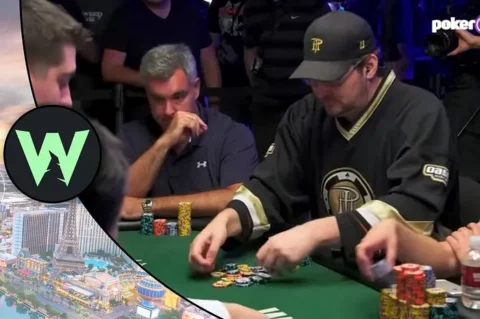
The streaming service PokerGO has delivered many a new “made for streaming” tournament series for poker fans. There seems to be one format, however, that PokerGO has not broached yet – a team competition. Here is a proposal for a team format that PokerGO might be able to get behind, and we’re going to name it for the Godfather of the game – the Doyle Brunson Cup, awarded to the winner of the competition between the U.S. and the world.
Similar Concept to Golf Team Competitions
The Doyle Brunson Cup would be similar in style to an activity that he enjoyed extensively, golf. The Ryder Cup is just a couple of weeks away, with two teams from the U.S. and Europe vying for a trophy that dates to 1927. In that format, points are earned for victories, and the team that emerges with the most points takes the trophy. It is a spirited competition that brings out the loyalties of both sides over the course of a few days of battle.
The Doyle Brunson Cup would be similar in that there would be twelve players for each squad. Six of the players for each team, U.S. and International, would be determined by the final Player of the Year standings (take your choice, either CardPlayer or the Global Poker Index). These six players would be locked in and, should they choose not to play, the next best player would be moved up.
This is 2025, so let’s propose that the first Doyle Brunson Cup will be contested in 2026. For the U.S., that would make their six automatic picks:
Jesse Lonis
Alex Foxen
Matthew Wantman
Ben Tollerene
Jeremy Ausmus
Shannon Shorr
For the International team, here are the six automatic picks:
Artur Martirosian
Punnat Punsri
Quan Zhou
Jose ‘Nacho’ Barbero
Kristen Foxen
Klemens Roiter
The alternates for both sides would be Brandon Wilson and Nick Schulman for the U.S., and Martin Kabrhel and Stephen Chidwick for the International team.
Each team will have a captain who is responsible for selecting the other six team members. These captains can choose anyone they want, regardless of ranking, to be on their team. This might result in some creative choices from the captains; can you imagine a U.S. team with Phil Hellmuth on it? What about an International team with William Kassouf?
The Format for the Brunson Cup
There are twenty-four players in this mix, and they will take part in four different disciplines of poker. These would be the four ‘sit and go’ tournaments that would be held.
Pot Limit Omaha
Seven Card Stud
Deuce-to-Seven Lowball
H.O.R.S.E.
In each SNG, the top three finishers will earn points – three points for first place, two points for second, and one point for third.
But we are not done yet! The final day of the Doyle Brunson Cup would be all twelve members of each team playing Heads Up No Limit Hold’em. A single point would be given to each winner of each NLHE match. The team that earns the most points by the end of the final day will win the Cup.
But wait! That’s not all…how about we throw in a curveball?
Five-Suited Decks – A Popular Trend from the Past
The traditional four-suited card decks have not always been the choice for card games. Five hundred years ago, FIVE suits were utilized in a 65-card deck (sixty-seven if you count the two Jokers). In the early 1900s, contract bridge introduced a fifth suit to its game, theoretically making it more challenging. The fifth suit has been designated as the 1937 “Royal Deck” (featuring a crown as the fifth suit), or the 1937 “Eagle Deck” (featuring an eagle) in the past. That fifth suit has also been designated as a star or a shield in more recent decks.
The addition of another suit to the festivities would completely change the mathematics behind whatever discipline of poker was being played. You might have to make some changes to the hierarchy of hands, adding in a five of a kind that beats a straight flush to the Ace, but that might be the only necessary adjustment (we’ll have to work the math on this to see if it makes getting a flush more or less likely…same with a straight). It would uproot the professional players from their normal mathematical calculations, making the game a bit tougher in theory.
What’s in it for Me?
Poker players aren’t going to do this simply for the honor of country (or international prestige). So, we need to come up with some compensation for the players to make it worthwhile for them (side note: poker players, the golfers in the Ryder Cup are not paid…just saying!). How about we put up this type of money:
$100,000 for each player on the winning team
$10,000 for each player on the losing team
$170,000 for each of the four SNG tournaments – first gets $100,000, second $50,000, third $20,000
That makes for a $5 million prize pool that the players are competing for. Makes playing for the country a lot more appealing, doesn’t it?
A Proposal for 2026
PokerGO has demonstrated a knack for inventing tournament formats that capture the attention of the poker audience. The Doyle Brunson Cup could be another success story for the streaming channel, fitting in right beside Poker Masters or the U.S. Poker Open in its plethora of events. We’re sitting by the phone for the call, Cary Katz…give us a ring and let’s see the 2026 Doyle Brunson Cup put on the PokerGO schedule!
The post A Proposal for PokerGO: The Doyle Brunson Cup appeared first on Poker News Daily.
About The Author