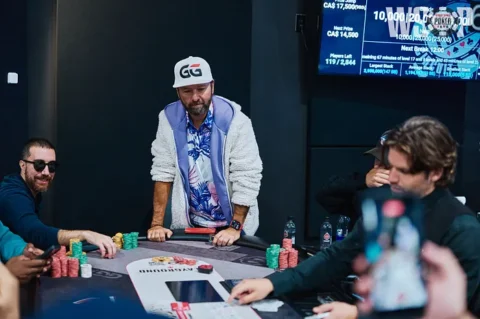
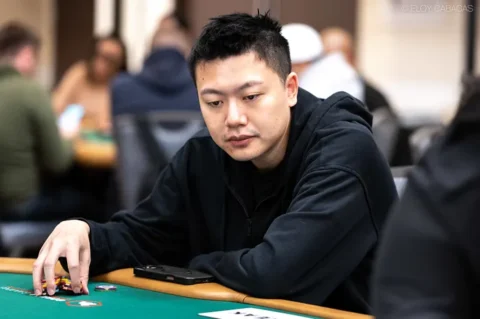
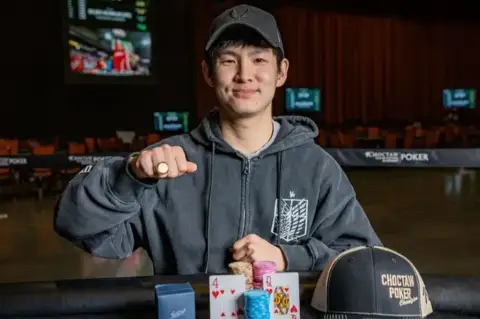
Alex Fitzgerald is a renowned American poker player who has won $680K in live tournaments and $3.3 million online. He is also a coach and has published five books with D&B Poker. We contacted Alex to discuss his latest book, “The 100 Biggest Mistakes that Poker Players Make,” and took the opportunity to ask him about his career and his deep runs in tournaments like the EPT and the PCA.
Alex Fitzgerald Interview
How did the idea of writing the book come about?
The idea for the book came up organically when my publisher and I were discussing what the next project should be. A book about the biggest mistakes poker players make seemed like a natural fit, especially as a way to help people improve their game quickly.
What type of players is it aimed at?
The book is aimed primarily at intermediate players, but there are definitely concepts that will apply to more advanced players as well. It starts by laying a solid foundation and then builds from there.
What reasons would you give our readers to read the book?
If your readers want my honest opinion on why most poker players do not succeed, this book gives it. I have never been a superstar poker performer, but by the grace of God I have managed to pay my bills from this game for decades, and I can tell you it is not intelligence that separates successful poker players from unsuccessful ones. It is the application of key fundamentals and a few important mindset shifts, and I think that becomes very clear by the end of the book.
Of the 100 mistakes you mention in the book, which three do you think are the most important to avoid?
The biggest one I start with is impatience. There are many very talented poker players who go broke because they become impatient for success and start to feel they are owed something. I once spoke with a World War II veteran who made money playing cards back then, and he also emphasized patience as the fundamental edge. It really is one of the easiest advantages you can have in poker. You often begin with an edge simply based on hand selection, and you do not want to give that up without a very good reason.
Another major mistake many people make is not taking rest days. I know it is fashionable for young men now to say “no days off,” but that is not realistic in a game like this. I have managed to survive 20 years in poker because I have hobbies away from the table that keep me sane when poker itself can be very insane.
Another common mistake is betting on autopilot. You should always know the reason for every bet you make. Getting information can be a byproduct, but it usually should not be the sole reason. You should know which hands you are targeting for value and which hands you are trying to bluff out. Often, when you really think through what is required to make certain bluffs work, you realize that an overbet is actually the better play. If you are not overbetting with some consistency, that can be a sign that you are not fully thinking through the purpose of your bets.

Do you have plans to write a new book in the future?
I would love to write another poker book in the future, but scheduling has been difficult. These days I do quite a bit of coaching, so finding four to six uninterrupted hours to write has been a challenge. Still, I hope another book can come together at some point.
You’ve cashed in and reached final tables on several continents. What were your three favorite places to play tournaments?
As for my favorite places to play tournaments, Las Vegas is always near the top of the list. That will not surprise many people. My friends and I have so many good memories in that city. There is always something to do, and a lot of people miss how much Vegas offers beyond poker. You can go hike Mount Charleston, catch comedy shows, visit unusual museums, and so much more. I love the balance of playing hard one day and then taking a day off to enjoy the city.
I also lived in South Korea for a time and fell in love with playing there. People always say Japan is an experience everyone should have once in life, and I agree completely. Japan is a beautiful country. But I also think every man should spend some time in Seoul if he can. It is an intense, unforgettable place, and I learned a great deal about myself there.
In Europe, my favorite place to play is the Czech Republic. I was fortunate enough to take my family there for Christmas, and it felt like a dream. It looks like something out of a Disney movie. The people are kind, and if you learn even a few words of Czech, they are incredibly welcoming. I love that city very much.
In 2009 you played in the final table of the EPT San Remo. What memories do you have of that tournament?
The San Remo tournament was, of course, a major moment in my life because it proved to me that I could play big tournament poker. But the memory that stands out most is playing Day 2 on only two hours of sleep. I had played Sunday tournaments the day before because the money was so good back then, and I finished 10th in a $500 event at around five in the morning. I was so wired afterward that I could not fall asleep, so I only got a couple of hours before Day 2. I really had to buckle down and make sure I did not give it away that day. I told myself that if I let it slip, I would regret it forever. I probably would not have made my only EPT final table if I had not dug deep that day.

Do you think you made any mistakes during the tournament?
I am sure I made a number of mistakes in that tournament, just like everyone did back then, because we knew so much less about tournament poker at the time. The main mistake I think I made was being too tight, because I was not quite ready for the moment yet. I was only 21. Still, I think I was directionally correct. In general, I was applying pressure to other players rather than allowing them to apply it to me. I just wish I had won that flip at the final table. Reaching one of those final tables after wanting it for so long feels like getting to walk on the moon. You never want to leave.
In 2012 you made a deep run in the PCA Main Event, finishing 14th. What do you think prevented you from advancing further and reaching the final table? Do you think you could have done something differently, or did the cards dictate your fate?
I am sure I made plenty of mistakes in the PCA a few years later as well, but again, I think I was directionally correct there too. People struggled with hero-calling much more back then because they were not always sure what they were supposed to call with against aggressive opponents. I understood that there were many situations where my opponent only had a very strong hand 10 to 20 percent of the time, and I made sure to apply pressure whenever those spots came up. It worked until it did not. There was one large bluff near the end that, if I remember correctly, was probably fine in theory, but I likely should have thought it through a little longer given the stage of the tournament. Still, I was learning, so I do not dwell on it too much. Embarrassment is part of the price of admission in this profession. You are going to make mistakes while you learn. There is no way around that. If you are not making mistakes, it probably means you are not pushing yourself hard enough.

In 2023 you cashed in the WSOP Main Event. What advice would you give to someone who qualified online and is going to play it for the first time?
If someone is trying to cash the Main Event for the first time, my advice is simple: remember they can only seat eight other people with you, and they can only make you play one hand at a time. Take your time on every hand and do not rush anything. Do not debut new material at Carnegie Hall. Do not try anything you have not already tried in smaller tournaments. Stick to the fundamentals. Do what makes sense to you, not something someone told you to do that you do not fully understand. Take the time you need. If people complain about how long you are taking, just explain that you are playing carefully in big spots and moving quickly when the decisions are easy. Take it one day at a time, and do not look at the payouts. On the bubble, be the one applying pressure to others, not the one calling off.
What goals and dreams do you have with poker?
As for my hopes and dreams in poker, I am pretty boring these days. I am just happy to still have a job in this game. If I can keep paying my bills from poker for another 20 years, I will be a very happy person. More than anything, I am just grateful to still be playing.
Book Information: By The Numbers
- Title: “The 100 Biggest Mistakes that Poker Players Make”
- Author: Alex Fitzgerald
- Year of Publication: 2022
- Pages: 124
- Amazon Rating: 4,3 ⭐️ (out of 5)
- Prices: $29,95 Paperback / $19,95 Kindle
- Where to buy it? D&B Poker and Amazon
Be sure to also read Paul Seaton‘s review of Alex’s book here.
About The Author