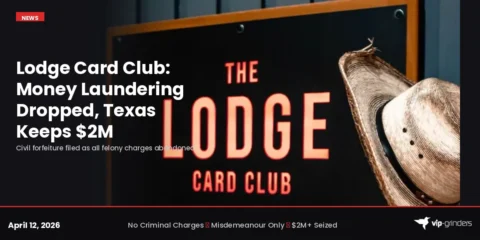
The Lodge Card Club civil forfeiture case has taken a sharp turn. Williamson County filed a claim to keep more than $2 million in seized assets, but dropped every felony allegation from the original raid.
The April 8 filing in the 480th Judicial District Court rests entirely on alleged illegal gambling, a Class A misdemeanour.
Money laundering and organised criminal activity charges have been abandoned. No criminal charges have been filed against anyone.
The filing landed one day before the 30-day statutory deadline under Texas law. Had the state missed the April 9 cutoff without acting, all seized assets would have been returned automatically.
Instead, co-owner Doug Polk and his Lodge ownership group now face what could be months or years of civil litigation to recover the money.
This is the seventh development in a story VIP-Grinders has tracked since the March 10 TABC raid and the April 9 deadline that just expired.
What Changed on April 8
The state’s nine-page forfeiture petition targets the seized property directly (an in rem proceeding) rather than naming individuals as defendants. This is standard for Texas civil forfeiture under Chapter 59 of the Code of Criminal Procedure.
- Filing date: April 8, 2026, one day before the 30-day statutory deadline under Chapter 59 of the Texas Code of Criminal Procedure.
- Court: 480th Judicial District Court, Williamson County. This is a civil proceeding filed against the property itself (in rem), not against individuals.
- Seized assets: approximately $1.35 million in cash (including a $435,000 IRS refund cheque), roughly $721,000 frozen from Tempus Holding Inc. bank accounts, plus computers and physical evidence.
- Charges dropped: all felony allegations (money laundering and organised criminal activity) have been removed. The filing rests solely on alleged illegal gambling, a Class A misdemeanour.
- Response deadline: The Lodge’s legal team has 20 days from service to file a Verified Answer contesting the forfeiture. Failure to respond triggers an automatic default judgment.
The seized cash breaks down into roughly $1.35 million taken from the premises (including a $435,000 IRS refund cheque found during the raid) and approximately $721,000 frozen from Tempus Holding Inc. bank accounts. All accounts associated with The Lodge’s operating entity remain frozen.
Why the Legal Downgrade Changes Everything
The original March 10 search warrant alleged five separate violations: engaging in organised criminal activity (Texas Penal Code §71.02(a)), money laundering, promotion of gambling, keeping a gambling place, and possession of a gambling device. All felony-level allegations are now gone.
This is the detail most coverage is burying. Headlines focus on “no criminal charges” as if that’s a win. The real story is the state dropping its strongest legal theories while still keeping the money through civil forfeiture.
The money laundering theory was always derivative rather than independent. As Polk explained in his March 31 YouTube statement, if the state classifies poker at The Lodge as illegal, then every associated financial transaction becomes “money laundering” by definition. The state apparently concluded it could not sustain that logic.
Proving illegal gambling against The Lodge now requires overcoming that statutory defence. TABC undercover agents played $1/$2 no-limit hold’em at The Lodge between April 2025 and January 2026.
On at least one visit, agents gained entry without being asked for membership proof. Other agents were required to purchase memberships. That factual dispute will likely become central to the civil case.

Polk’s Seven-Figure Pledge and the Status of Player Funds
Polk broke his public silence on March 31 with a 22-minute YouTube video containing his most direct statement since the raid. His core pledge: if The Lodge cannot make players whole, he will personally cover the liabilities. He characterised this as a voluntary personal commitment.
The outstanding liabilities include cash game chip balances, tournament payouts, and pending wire transfers. The largest single obligation is the $203,990 first-place prize won by Wayne Harmon in the Lodge Championship Series Main Event, which concluded just 16 hours before the raid.
With all Tempus Holding bank accounts frozen by the forfeiture action, no disbursements can happen until the civil case resolves or the court releases specific funds.
Brad Owen issued a brief defence of Polk on X shortly after the raid. Andrew Neeme has been completely silent. Other minority investors, including Nik Airball and Ethan “Rampage” Yau, have said nothing publicly.
What This Means for Texas Poker
The Lodge is not an isolated operation. As of late 2024, 68 active private poker clubs operated across Texas under the same seat-fee model, with roughly 876 tables between them.
Houston alone hosts 18 clubs. All rely on the §47.02(b) defence.
No other Texas poker rooms have been raided since March 10. Most continue operating, including Texas Card House’s six locations. The Lodge may have been uniquely vulnerable because its TABC mixed beverage permit gave the Financial Crimes Unit jurisdiction that it would not have over a dry club.
On the legislative front, nothing is moving. Two competing poker bills introduced in the 2025 Texas session both died without advancing. The legislature only meets every two years in odd-numbered years, so the next session doesn’t start until January 2027.
What Happens Next
The Lodge has been continuously closed since March 10 with all 200-plus staff laid off. Co-owner Jason Levin told employees the Williamson County DA made clear the current business model does not comply with Texas law, and reopening would risk another raid and potential arrests.
- 20-day answer window: The Lodge must file a Verified Answer to contest the forfeiture. This is expected, given Polk’s public statements.
- Civil discovery: if contested, the case enters standard civil discovery. Texas expedited forfeiture actions allow up to 180 days. Contested cases typically resolve in 6 months to over 2 years.
- Burden of proof: the state must show by a preponderance of the evidence that the seized property is connected to criminal activity. No criminal conviction is required under Texas law.
- Legislative timeline: the Texas Legislature meets only in odd-numbered years. No legislative fix is possible until the January 2027 session.
The complete absence of criminal charges 33 days after seizure, combined with the abandoned felony theories, gives The Lodge genuine leverage to fight. The Lodge Card Club civil forfeiture path could still take months or years, but the dropped charges weaken the state’s position.
For Texas-based players looking for online options while the Lodge stays dark, ACR Poker and CoinPoker both accept US players. ACR’s $10M Dual Venom series running through April 28 with satellites from $0.01. CoinPoker’s Heads Up Cash Game World Championship runs through May 3 with a $100,000 first prize.
For ongoing coverage, follow our poker news page.
Der Beitrag Lodge Card Club: Money Laundering Dropped, but Texas Keeps $2M Through Civil Forfeiture erschien zuerst auf VIP-Grinders.
About The Author