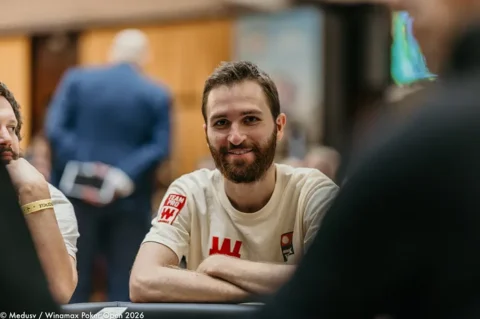
Poker player, coach, father of four, and author James “SplitSuit” Sweeney released a new book a few months ago titled “The Low Stakes Poker Playbook”. We reached out to him to ask about the book, and following the interview, you’ll find a brief review containing our thoughts on the work.

Interview with James Sweeney
How did the idea to write this book come about?
After writing “The Exploitative Edge“, Adam and I wanted to bridge the gap between understanding exploitation and actually executing it. So many players recognize their opponents’ mistakes but struggle to pull the trigger on the appropriate counter-strategy. We wanted to give players something incredibly actionable.
What type of poker players is it aimed at?
Primarily low-stakes cash game players who already understand the fundamentals but want to increase their winrate. That said, I think even experienced winning players will find exploits they are currently overlooking or not pushing nearly hard enough.
How does this book differ from “The Exploitative Edge”?
“The Exploitative Edge” teaches you how to construct exploits. “The Low-Stakes Poker Playbook” gives you 99 specific exploits you can start implementing immediately. One is the strategic framework, and the other is the field manual. They complement each other extremely well.
Can the advice you provide be applied to live poker games, or is it primarily for online poker games?
Both, and arguably many of these exploits are even more powerful in live games. While online players have the benefit of database analysis, live players often face opponents with much larger and more obvious leaks. There’s also an entire chapter on timing tells, physical tells, and recent history, which is about as live as poker gets. The underlying mechanics of exploitation are the same regardless of where you’re playing.
I was surprised that there isn’t a single solver chart in the entire book. Was your intention to keep the concepts simple and concise?
Keeping the book light on charts and heavy on actionable strategy was very intentional. Solvers are incredible study tools, but I think many players have become overly concerned with replicating solver outputs rather than understanding how to make money against imperfect opponents. We wanted every exploit to be digestible, memorable, and executable without needing to memorize a bunch of charts.

In one of the exploits, you recommend varying your pre-flop raise size based on the strength of your hand. Don’t we run the risk of becoming predictable and being exploited by our opponents?
In theory, yes. But there’s a massive difference between being exploitable and actually being exploited. If my opponents aren’t adjusting, why should I sacrifice EV to protect myself? And if they do start adjusting to my sizing, I now have an opportunity to reverse the exploit and punish their adjustment.
This is the first time I’ve seen a chapter in a poker book specifically dedicated to bots. Do you think this is a serious problem in online poker today?
Absolutely, especially when you also factor in RTA (real-time assistance). But bots aren’t necessarily unbeatable, and some have incredibly exploitable tendencies precisely because of how they’re programmed. One exploit in the book is based on a real-world example where exploiting a single bet-sizing weakness netted over 50 buy-ins against a bot ring in a matter of hours. We felt it was important to discuss both the reality of the modern online landscape and how players can adapt to it.
What advice would you give to someone about to play their first live $1/$2 No Limit Hold’em game at their nearest casino?
Pay attention, even when you’re not involved in a hand. Watch what people show down, how they size their bets, and what mistakes they repeatedly make. Pick one or two exploits you expect to see, like iso-raising limpers or value betting thinner against calling stations, and focus on just those. Don’t feel pressured to make fancy plays, and certainly don’t judge the quality of your decisions based on the financial results of a single session.
How are you balancing fatherhood with poker? Is it difficult to find time to work, study, and play?
With four boys, three of them still young, free time is certainly at a premium these days! I’ve had to become much more intentional with how I spend my time, both at and away from the tables. Poker is incredibly important to me, but it will never be more important than being a dad.
What reasons would you give our readers to read the book?
Most players are almost certainly leaving money on the table without realizing it. If just a handful of the 99 exploits improve your game, the book can easily pay for itself many times over. More importantly, I hope it changes the way you think about poker and gives you the confidence to deviate from your default strategy when your opponents give you a reason to.
Book Information: By The Numbers
- Title: “The Low-Stakes Poker Playbook”
- Subtitle: “99 Proven Plays To Exploit Real Players”
- Authors: James “Splitsuit” Sweeney & Adam “W34z3l” Jones
- Year of Publication: 2026
- Pages: 141
- Prices: $9.99 Kindle / $19.99 Paperback
- Where to buy it? Red Chip Poker & Amazon
- You can read an excerpt of the book here

Poker Book Review: “The Low Stakes Poker Playbook”
This new book by James Sweeney follows the same approach as his previous one, “The Exploitative Edge”: it is short, gets straight to the point, and avoids tedious mathematical explanations or an abundance of solver charts. In fact, there isn’t a single chart in the entire book — something that readers looking for brief, concise information will surely appreciate.
The first thing to clarify is that this book will be useful for low-stakes cash game players, both online and live. The author provides a total of 99 tips for use at the tables which, if applied successfully against specific types of opponents, can help players maximize their profits.
Across the book’s 15 chapters, the authors cover a wide range of topics, such as pre-flop isolation, sizing exploits, over-raising, multiway strategies, thin value, setting traps, tight laydowns and donk betting — along with other contemporary subjects relevant to today’s poker tables.
As mentioned in my questions to James above, one thing that pleasantly surprised me about the book is that, for the first time, I saw an entire chapter dedicated to playing against bots. Unfortunately, bots are commonplace in many online poker rooms, and it is crucial to know how to adapt our play to face programmed, virtual opponents.
To wrap up this review, I would say that it is a short, fast-paced poker book that explains concepts in a clear and simple way. If you are a low-stakes cash game player you should read it, as it can provide you with new poker strategies and tips, as well as perspectives for exploiting the mistakes, tendencies, and weaknesses of your opponents at the table.

About The Author