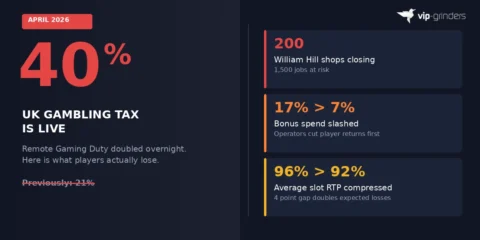
The UK’s Remote Gaming Duty doubled from 21% to 40% on 1 April 2026. Within 24 hours, Evoke announced 200 William Hill shop closures and 1,500 jobs at risk. The tax now makes the UK the most expensive online casino market in Europe alongside Austria, and it will reshape what British players see in their accounts: thinner bonuses, compressed RTPs and a regulated product that gets worse month on month.
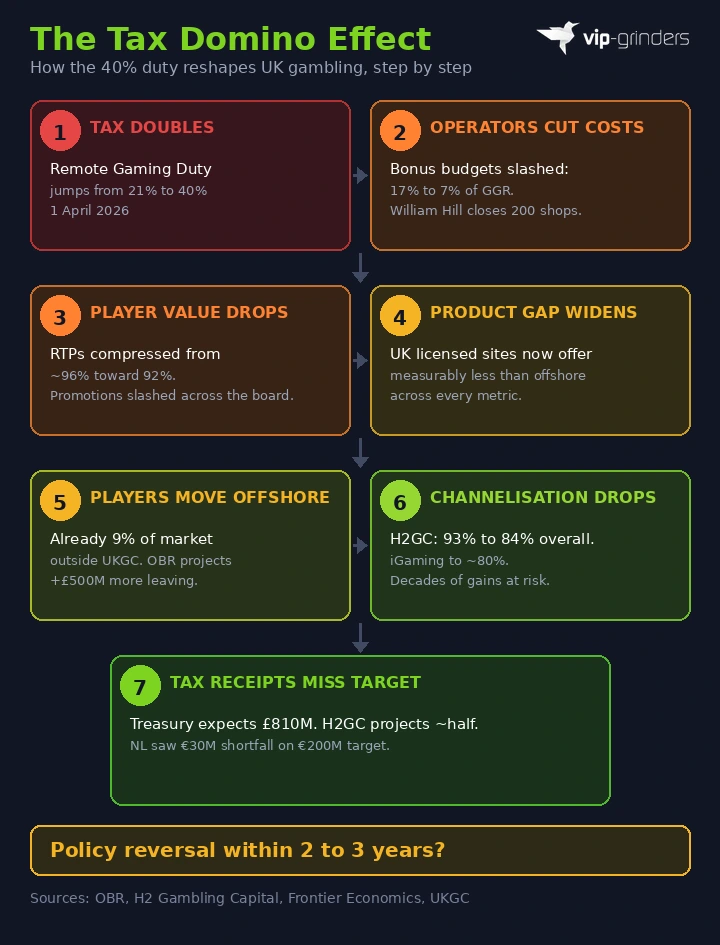
The Treasury expects to collect £810 million in the first year. Independent analysts at H2 Gambling Capital project actual revenue at roughly half that figure, because the government’s own forecasts assume players and operators will behave as if nothing changed. They won’t.
In our analysis of the 40% tax and unlicensed platform problem earlier this year, we warned this policy would push players toward offshore and unregulated sites. That prediction is now playing out in real time. Here is what the tax actually changes for UK poker and casino players, what operators are doing to absorb the hit, and what the evidence from the Netherlands, Germany and Italy tells us about where this market is headed.
What Changed on 1 April 2026
The Finance (No.2) Bill 2024–26 restructured how the UK taxes online gambling. The headline change is Remote Gaming Duty jumping from 21% to 40% on gross gaming yield for all online casino, slots and bingo products. Sports betting faces its own increase, from 15% to 25%, but that does not kick in until April 2027.
The New Tax Rates at a Glance
| Tax | Old Rate | New Rate | Effective Date |
|---|---|---|---|
| Remote Gaming Duty (online casino/slots/bingo) | 21% | 40% | 1 April 2026 |
| Remote Betting Duty (online sports betting) | 15% | 25% | 1 April 2027 |
| General Betting Duty (land-based shops) | 15% | 15% (unchanged) | N/A |
| Bingo Duty | 10% | Abolished | April 2026 |
| Statutory Gambling Levy | None | 1.1% of GGY | October 2025 |
Players Do Not Pay the Tax Directly, But They Will Feel It
UK gambling winnings remain tax free. The 40% duty lands on operators, not players. But the OBR explicitly estimated that operators will pass approximately 90% of the cost increase to consumers through worse odds, smaller bonuses and reduced payouts.
That pass-through is not speculation. It is built into the Treasury’s own revenue model. The distinction between “operator tax” and “player tax” is technically correct and practically meaningless.
The Government’s Revenue Projections vs Reality
Chancellor Rachel Reeves announced the tax as part of the November 2025 Autumn Budget. The Treasury projected an additional £810 million in 2026/27, rising to £1.16 billion per year by 2030/31.
Those projections assume a largely static market. The OBR itself acknowledged that behavioural responses would reduce the yield by approximately one third. H2 Gambling Capital went further, estimating actual revenue at roughly half the Treasury’s static forecast and warning that gross gambling yield could drop £1.1 billion (14%) as operators cut marketing, exit unprofitable segments and players migrate offshore.
A public consultation on remote gambling taxation ran from April to July 2025, receiving 143 responses. The original proposal was a single merged Remote Betting and Gaming Duty. After industry pushback, the government abandoned that model and created differentiated rates that hit casino and slots operators hardest.
William Hill Closes 200 Shops as Operators Scramble
The first casualty arrived before the tax even took effect. On 31 March 2026, Evoke Plc confirmed the closure of approximately 200 William Hill betting shops, roughly 15% of its 1,300 store estate. The closures begin on 24 May 2026 and put up to 1,500 jobs at risk.
Evoke faces annualised additional duty costs of £125 to £135 million. The company plans to mitigate roughly half of that through supplier savings, marketing cuts and what it called “changes to customer proposition.” That last phrase is corporate language for worse bonuses and tighter promotions.
CEO Per Widerström called the tax changes ill-thought-through, counterproductive, and highly damaging. Deutsche Bank responded by cutting Evoke’s FY26 and FY27 EBITDA forecasts by 12% and 18% respectively, projecting earnings per share to fall 40% in 2026 and 52% in 2027.
The Damage Across Every Major Operator
William Hill is the most visible casualty, but every major UK operator has disclosed significant financial hits.
| Operator | Key Brands | Estimated Annual Impact | Response |
|---|---|---|---|
| Flutter | Paddy Power, Betfair, Sky Bet | $320M EBITDA (2026), $540M (2027) | Relocated Sky Bet HQ to Malta. Closed 57 Paddy Power shops. |
| Entain | Ladbrokes, Coral | ~£200M per year | CEO said UK no longer priority for investment. |
| Evoke | William Hill, 888 | £125–135M annualised | 200 shop closures. Strategic review with Morgan Stanley. |
| Betfred | Betfred | Not disclosed | Chairman warned all 1,300 shops and 7,500 jobs at risk. |
| bet365 | bet365 | Not disclosed | Local MP raised alarm over 5,500 jobs in Stoke-on-Trent. |
The Consolidation Play
Wall Street’s response reveals how the market reads this situation. Jefferies described the tax as “worse than expected.” Yet UBS, Deutsche Bank and Jefferies all recommended buying Flutter and Entain shares, betting that scale operators will absorb customers from collapsed competitors.
It comes down to simple math. Smaller operators cannot absorb a near doubling of their tax bill. The options left for mid-tier and smaller firms are limited:
- Exit the UK market entirely
- Sell at distressed prices to a larger competitor
- Cut bonuses, RTPs and promotions so aggressively that players leave anyway
The large operators lose money in absolute terms but gain market share. For players, that consolidation means fewer choices. Fewer operators competing for your business means less pressure to offer strong rakeback, generous bonuses or competitive odds.
How This Hits Your Bonuses, RTPs and Promotions
The tax is levied on operators. But every major operator has named the same primary mitigation strategy: reduce what they give back to players. That means the 40% rate translates directly into a worse experience for anyone using a UKGC licensed site in 2026.
Bonuses Are Getting Cut in Half
H2 Gambling Capital projects that iGaming bonus spending will drop significantly, from roughly 17% of gross gaming revenue to approximately 7%, once operators fully adjust to the new tax rate. Larger operators are expected to cut bonus spend from about 12% to 6% of GGR. Smaller operators may slash from 25% to 12%.
In practice that means smaller welcome offers, fewer reload bonuses, reduced cashback and less frequent free bet promotions. Every operator listed “reduced marketing and promotions” as their primary cost mitigation tool in their post-Budget disclosures.
RTPs Face Downward Pressure
When an operator pays 40% of gross gaming yield in tax instead of 21%, the margin available for player returns shrinks significantly. Industry sources cited by Techopedia warn that average RTPs on UK licensed sites could fall from the typical 96% to 92% or lower as operators look to recover margins.
That 4 percentage point gap matters over volume. A player wagering £10,000 over a month at 96% RTP expects to lose £400. At 92% RTP, the expected loss rises to £800. For regular grinders, that is a material difference in long-term EV.
The Restriction Stack
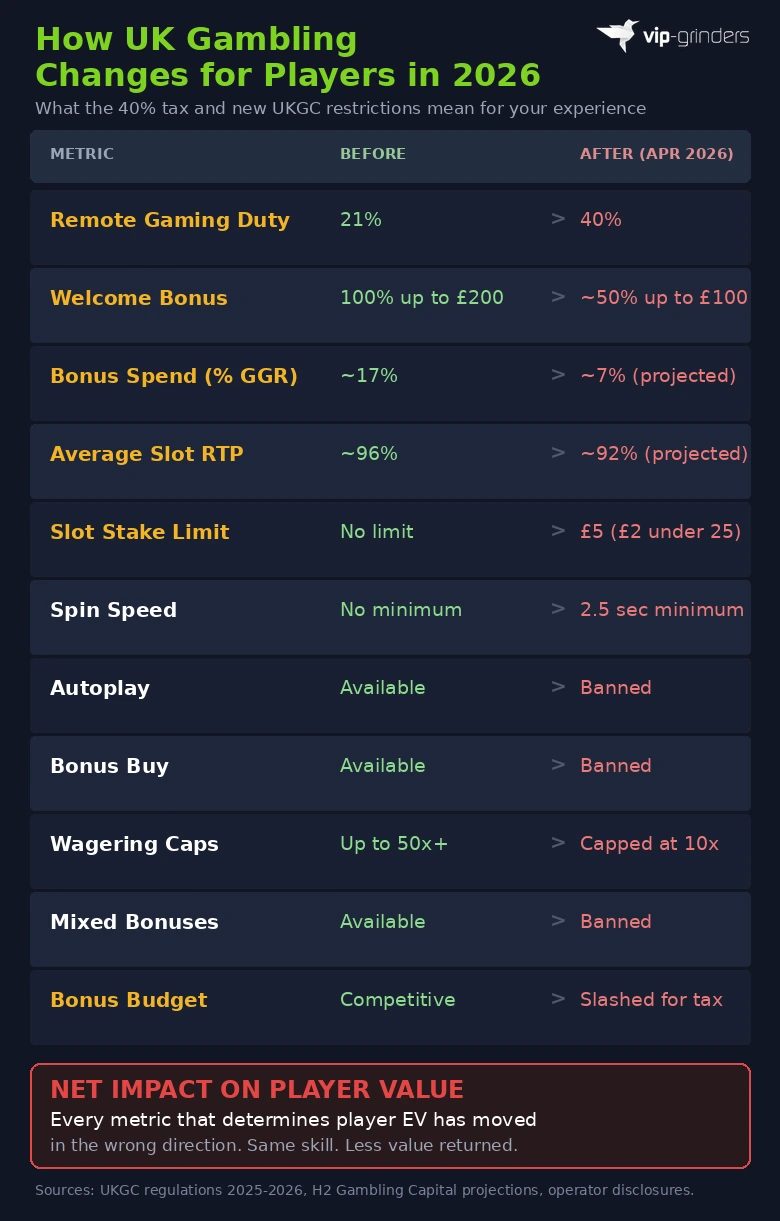
None of this exists in isolation. It lands on top of a wave of product restrictions the UKGC rolled out through 2025 and into 2026. Each rule sounds reasonable on its own. Stacked together, they create a licensed experience that is measurably inferior to what exists outside the UKGC system.
- £5 online slot stake limit (£2 for under-25s)
- Mandatory 2.5 second minimum spin duration
- Autoplay banned on all online slots
- Bonus buy features prohibited
- Wagering requirements capped at 10x from January 2026
- Financial vulnerability checks triggered at £150 in net deposits within 30 days
- Mixed product bonuses banned (e.g. bet £10 on football, get 50 free spins)
None of these restrictions apply to offshore operators. A player comparing a UK licensed casino to a crypto casino with provably fair games now sees a wider product gap than at any point in the last decade.
What This Means for Poker Players
The 40% tax applies to rake and tournament fees as part of the operator’s gross gaming yield. No UK licensed room has publicly announced poker specific changes yet, but the economic pressure is clear.
- Rake increases become likely as operators protect margins
- Tournament guarantees may shrink to reduce overlay risk
- Promotional events and leaderboard prizes are early candidates for cuts
The UK regulated poker ecosystem was already thin compared to crypto poker platforms with transparent rake, and the 40% tax only widens that gap.
For grinders who track their effective rakeback percentage and EV per session, the math is shifting. The same volume on a UK licensed site now returns less value than it did 30 days ago, with no change in the player’s own skill or approach.
The Unregulated Market Is Already Growing
Everything described above has not even taken full effect yet. The bonus cuts, RTP compression and operator exits will play out over the coming months. But the share of UK players choosing platforms outside the UKGC system is already growing fast.
The Numbers Right Now
According to Yield Sec/GCI data, unlicensed operators control approximately 9% of Britain’s online gambling market as of early 2025. That is up from 2% in 2022 and just 0.43% in 2020. A roughly 20 fold increase in five years, before the 40% tax even arrived.
| Metric | Figure | Source |
|---|---|---|
| Annual stakes with non-UKGC operators | £4.3 billion | Frontier Economics / BGC |
| Estimated UK unlicensed market users | 1.5 million | BGC 2026 AGM |
| Unlicensed share of online total | ~9% | Yield Sec / GCI |
| Growth since 2020 | ~20x | Yield Sec / GCI |
| Additional unlicensed spend projected by OBR | £500 million | OBR / Treasury |
That last row is the most striking. The government’s own forecaster projects this tax will redirect an additional £500 million to operators outside the UKGC system. That is not an industry estimate or a lobbying figure. It is baked into the Treasury’s own model as an accepted cost of the policy.
Why Players Choose Offshore
A Frontier Economics study commissioned by the BGC surveyed players using unlicensed sites on their motivations. The results map directly to every feature the UK government is either taxing away or restricting.
| Reason for Choosing Non-UKGC Platforms | % of Users |
|---|---|
| Better bonuses and free bets | 35% |
| Easier account setup (no checks) | 32% |
| More flexible payments including crypto | 30% |
| Better odds | 30% |
Every single motivation in that table corresponds to something the 40% tax and UKGC restrictions make worse on the licensed side. Better bonuses? Operators are cutting them in half. Easier setup? Affordability checks now trigger at £150. Crypto payments? No UKGC licensed operator accepts them. Better odds? The 90% pass-through compresses margins across the board.
Enforcement Cannot Close the Gap
The UKGC has ramped up enforcement significantly. Between October 2024 and September 2025, it sent 806 cease and desist letters, geo-blocked 314 websites, and referred over 102,000 URLs to Google. The government launched an Illegal Gambling Taskforce in January 2026 and committed £26 million over three years to the Gambling Commission specifically to target unlicensed operators.
But those numbers need context. There are an estimated 700 unlicensed operators active in the UK, promoted by over 1,600 affiliates. The UKGC itself acknowledged it faces what Executive Director Tim Miller called an “inequality of arms” against unregulated operators.
H2GC projects onshore channelisation will fall from approximately 93% to 84% for the combined online market, with iGaming specific channelisation dropping to around 80%. Offshore gross gaming yield could grow 111% by FY28. If those projections hold, the UK will lose in two years the channelisation advantage it spent two decades building.
Europe Already Tried This: The Results Are In
The UK is not running an experiment. It is repeating one. Three European markets have already combined high online gaming taxes with strict product restrictions, and in every case the licensed market shrank while offshore alternatives grew.
We covered these parallels in detail in our earlier article on the Premier League sponsorship ban and 40% tax. Here is the summary table updated with the latest available data.
What Happened in Each Market
| Country | Tax Rate | Key Restriction | Licensed Market Share | Result |
|---|---|---|---|---|
| Netherlands | 34.2% (37.8% planned) | Deposit limits: €300/€700 per month | ~50% (revenue based) | Licensed GGR dropped 14% in H1 2025. Offshore GGR hit €617M. |
| Germany | 5.3–7% turnover (~50%+ effective) | €1 slot stake limit | ~40% overall, ~20% slots | Slot tax receipts fell 50%. 60 to 80% of slot activity is offshore. |
| Sweden | 22% | Welcome bonus ban | 74 to 86% overall, ~60% casino | Traffic to unlicensed sites up tenfold since 2019. |
| Italy | 24–25% | Total advertising ban (2019) | Not measured precisely | Estimated €1 billion per year lost to offshore operators. |
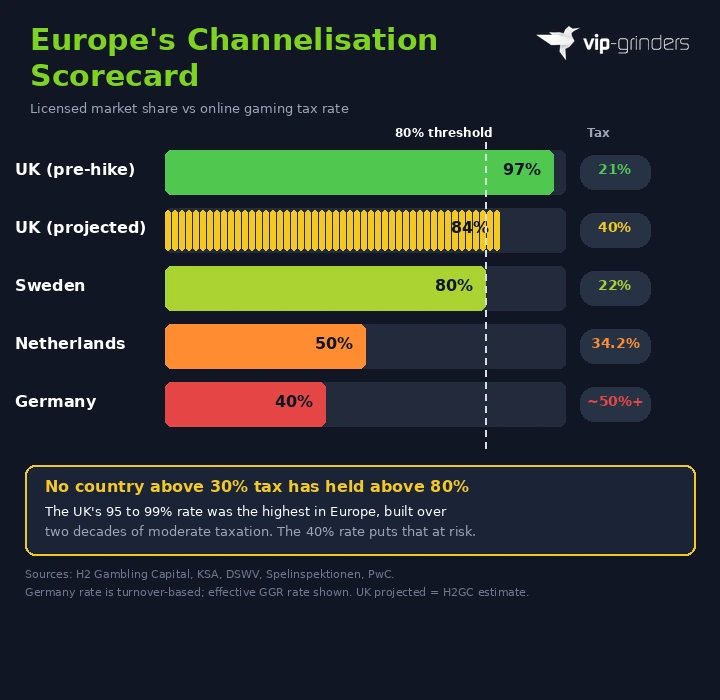
| UK (pre-hike) | 21% | Moderate | 95 to 99% | Highest in Europe. Built over two decades of pragmatic regulation. |
| UK (post-hike) | 40% | £2/£5 stake limits + affordability checks | TBD | H2GC projects drop to ~84% overall, ~80% for iGaming. |
The Netherlands: The Closest Mirror
The Dutch trajectory is the most directly relevant because its tax path almost exactly mirrors the UK’s. The Netherlands raised its online gaming tax from 29.5% to 34.2%, with 37.8% planned. Combined with mandatory deposit limits, licensed operator revenue dropped 14% in the first half of 2025. Offshore operators collected an estimated €617 million in that same period, overtaking the licensed market in revenue terms for the first time.
The Dutch government expected an additional €200 million in tax revenue. Instead it recorded a €30 million shortfall. Higher rates, less money collected. KSA Chairman Michel Groothuizen acknowledged the dynamic directly: stricter regulation widens the gap between licensed and unlicensed products, making offshore platforms more attractive by comparison.
Germany: What Happens When You Cap Stakes Too Low
Germany’s Interstate Gambling Treaty imposed a €1 online slot stake limit alongside a turnover tax that translates to an effective GGR rate above 50%. Licensed operators were forced to reduce RTPs to 87 to 88% compared to the industry standard of 95%+. Players responded predictably.
Tipico’s iGaming Director stated that more than 60% of German players prefer offshore alternatives. A Hessian Tax Court ruling assessed the offshore share for virtual slots at likely over 80%. Online slot tax receipts fell 50% after the turnover tax was introduced.
The Pattern Across All Four Markets
A PwC study of 17 European jurisdictions found a clear correlation between tax rates and licensed market performance. Countries with GGR tax rates below 25% achieved 13% annual growth in tax receipts. Those above 25% achieved only 9%. Higher rates, slower growth in actual revenue collected.
No country that has pushed its online gaming tax above 30% has maintained licensed market share above 80%. The UK is now at 40%, starting from the strongest position in Europe, and betting it will be the exception. Every data point from the continent suggests otherwise.
What Happens Next
Based on every available data point from the tax structure, operator disclosures and European precedent, the UK gambling market is heading toward a predictable set of outcomes over the next 12 to 24 months.
For Operators
- 1Smaller operators will exit or get acquired. Any UK focused operator without the scale to absorb a 40% GGY tax faces a binary choice: sell or shut down. Evoke’s strategic review with Morgan Stanley is likely the first of several.
- 2Flutter and Entain will gain market share. Both have the international diversification to absorb UK losses. Fewer competitors means less pressure to compete on price or promotions.
- 3More operators will relocate offshore. Sky Bet’s move to Malta saved £55 million. Others will follow the same playbook to reduce their UK cost base.
For Players
- 1Bonuses and promotions will keep shrinking. Operators are still in the early stages of adjusting. The full impact on welcome offers, cashback and free bets will become visible over Q2 and Q3 2026.
- 2RTPs on UK licensed sites will compress further. Expect the gap between what UKGC sites offer and what offshore platforms offer to widen through the rest of 2026.
- 3More players will move to offshore platforms. Not because they are doing something wrong, but because the licensed product is offering less value for the same money. This is a rational consumer response to a pricing gap.
For the Government
The Treasury’s £810 million revenue target for 2026/27 will almost certainly come in below forecast. The OBR already discounted it by one third. H2GC projects half. If the UK follows the Dutch trajectory, where a similar tax path produced a €30 million shortfall instead of €200 million in gains, a policy reversal within two to three years becomes a real possibility.
The government has acknowledged it will redirect £500 million more to offshore operators as a cost of this policy. Whether it acknowledges the follow-on effects, fewer jobs, lower tax receipts, weaker player protections for the 1.5 million Britons already outside the UKGC system, depends on how quickly the data becomes impossible to ignore.
What We Are Watching
VIP-Grinders has tracked poker and gambling regulation since 2013. We have seen markets over-correct and course-correct across dozens of jurisdictions. Three indicators will tell us whether the UK follows the European pattern or finds a different path:
- 1UKGC channelisation data for Q2 and Q3 2026. If licensed market share drops below 90%, the alarm bells are real.
- 2Whether the UKGC opens a crypto payment pathway. Tim Miller confirmed crypto is one of the top two drivers pushing players outside the system. If the regulator moves on this in 2026, it signals pragmatism. If it does not, the product gap keeps widening.
- 3Actual tax receipts vs the £810 million target. This is the number that will determine whether the policy survives or gets revised. Every European market that saw a revenue shortfall after a tax hike eventually reconsidered.
We will continue covering this as the data comes in. For now, the direction is clear: the UK built the strongest licensed gambling market in Europe through moderate taxation and a competitive product. That model ended on 1 April 2026.
FAQs
What is the UK gambling tax rate in 2026?
Remote Gaming Duty on online casino, slots and bingo rose from 21% to 40% on gross gaming yield on 1 April 2026. Remote Betting Duty on online sports betting will increase from 15% to 25% on 1 April 2027. Land-based betting shop duty stays at 15%.
Do UK players pay tax on gambling winnings?
No. UK gambling winnings remain completely tax free for players. The 40% duty is paid by operators on their gross gaming yield (stakes minus winnings). However, the OBR estimates operators will pass roughly 90% of the additional cost to players through worse odds, smaller bonuses and lower RTPs.
Why is William Hill closing 200 shops?
Parent company Evoke Plc announced the closures on 31 March 2026, citing annualised additional duty costs of £125 to £135 million from the tax increase. Roughly 15% of William Hill’s 1,300 store estate will shut from 24 May 2026, putting up to 1,500 jobs at risk.
How will the 40% tax affect bonuses and RTPs?
H2 Gambling Capital projects iGaming bonus spending will drop from roughly 17% to 7% of gross gaming revenue. Industry sources warn average RTPs on UK licensed sites could fall from the typical 96% to 92% or lower as operators try to recover margins under the new rate.
What is channelisation and why does it matter?
Channelisation measures the percentage of gambling activity that happens on licensed, regulated platforms. Before the tax hike, the UK had the highest rate in Europe at 95 to 99%. H2GC projects this will fall to around 84% overall and 80% for iGaming, meaning more players will move to platforms outside the UKGC system.
What happened in other countries that raised gambling taxes?
The Netherlands saw licensed operator revenue drop 14% after raising its tax to 34.2%, with offshore platforms overtaking the legal market for the first time. Germany’s effective 50%+ rate pushed 60 to 80% of online slot activity offshore. Sweden’s licensed market share fell well below its 90% target. A PwC study of 17 European markets found that countries taxing above 25% consistently collected less revenue growth than those below 25%.
Der Beitrag UK’s 40% Gambling Tax Is Live: What Players Actually Lose Starting April 1 erschien zuerst auf VIP-Grinders.
About The Author