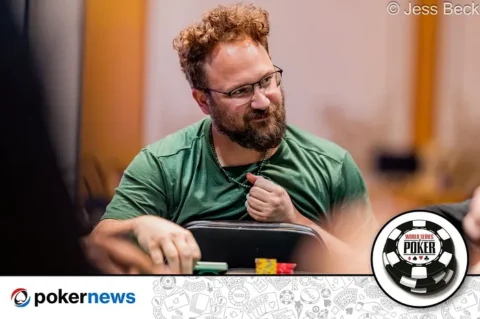
Lucas Jumalon has never won a title that mattered. On Monday he sits down at poker’s biggest final table with 194,000,000 chips, 129 big blinds and eight players in his way.

All nine return to Paris Las Vegas to play it down over three days. First place pays $10,000,000.
The final nine were set on July 13 and then waited 20 days, the first delayed Main Event final table since 2016. Chip counts and live updates run on our WSOP 2026 Main Event page.
They return to a rule that changed twice in under three weeks. The shot clock introduced on Day 7, the first in the event’s 57-year history, was scrapped on July 30.
The August Nine: Who Actually Wins the WSOP 2026 Main Event Final Table
Jumalon holds roughly 35% of the chips. The gap back to second is 115,000,000, and no other finalist has a nine-figure stack.
His stack runs to more than three times the average of 61,386,667. The four mid-stacks hold roughly as many chips between them as he holds alone.
| Player | Country | Chips | Big Blinds |
|---|---|---|---|
| Lucas Jumalon | United States | 194,000,000 | 129 |
| Rami Hammoud | Canada | 79,000,000 | 53 |
| Jamie Shaevel | United States | 56,000,000 | 37 |
| Greg Mueller | Canada | 48,500,000 | 32 |
| Michael Gagliano | United States | 46,500,000 | 31 |
| Mario Boos | France | 44,000,000 | 29 |
| Lauri Saaskilahti | Finland | 37,500,000 | 25 |
| Han Feng | United States | 25,000,000 | 17 |
| Evagoras Evagorou | Cyprus | 22,500,000 | 15 |
Lucas Jumalon Has 129 Big Blinds and Nothing to Lose
Jumalon can attack every stack at the table without risking his own tournament. He covers second place twice over.
Solver work on the actual final table stacks by analyst Matt Hunt gives him a 32% opening range. Facing it, the big blind is pushed into a narrow three-betting range of aces, kings and bluffs, with queens not strong enough to raise for value.
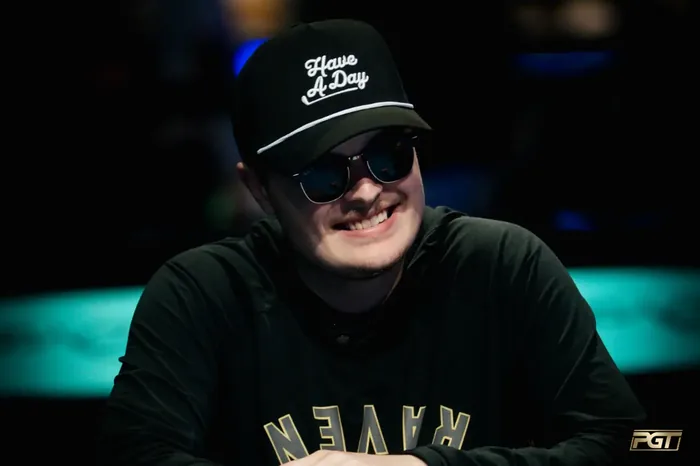
He is 22, from Spokane, and a recent Grand Canyon University graduate. He learned the game in home games under the guidance of his father, Butch Jumalon.
- Over 100 big blinds (Jumalon): can open wide, three-bet light and fold to resistance without ever being committed. No hand he plays threatens his tournament.
- 40 to 55 big blinds (Hammoud): deep enough to three-bet and fold, which makes him the only player who can contest pots with the chip leader on anything close to equal terms.
- 25 to 37 big blinds (Shaevel, Mueller, Gagliano, Boos, Saaskilahti): raise-or-fold territory. Once chips go in pre-flop they are usually committed, so every decision is a stack decision.
- Under 20 big blinds (Feng, Evagorou): shove or fold. Post-flop play barely exists at this depth and there is no room to apply pressure to anybody.
Rami Hammoud Is the Only Player With Room to Fight Back
At 53 big blinds Hammoud is the one finalist who can three-bet the chip leader and still fold to pressure. Everybody else is playing a shove-or-fold game against Jumalon.
The Canadian has been grinding tournaments for over a decade. His previous best came at Playground Poker Club in 2023, where he turned a C$1,150 buy-in into C$166,000.
Greg Mueller and Michael Gagliano Bring the Only Bracelets
Between them they hold six WSOP bracelets, and neither has a comfortable stack. Mueller has 32 big blinds, Gagliano 31.
Mueller’s live experience matters more without a clock. Born in Switzerland, he played professional hockey in Germany for nearly a decade before turning to poker, and has 72 WSOP cashes to his name.
His three bracelets include two won 11 days apart in 2009, in the $10,000 Limit Hold’em and the $1,500 Limit Hold’em Shootout. The third came in the 2019 $10,000 H.O.R.S.E.
Gagliano has spent nearly two decades in tournaments. He won his first bracelet in 2016 in the $2,500 No-Limit Hold’em at the Rio and has added two more in online events.
The Five Chasing a Career-Best Result
Han Feng and Evagoras Evagorou have the shortest stacks and the simplest job. They shove or fold, and let the middle stacks agonise over pay jumps.
- Jamie Shaevel (56,000,000, 37 big blinds): a Chicago cash game player and Midwestern circuit regular with seven previous Main Event cashes. This is comfortably the deepest run of his career.
- Mario Boos (44,000,000, 29 big blinds): the Frenchman had never cashed the Main Event before this year. He normally plays events with buy-ins below $1,000.
- Lauri Saaskilahti (37,500,000, 25 big blinds): a European circuit regular living in Spain. His run is the deepest and richest any Finnish player has managed in the Main Event.
- Han Feng (25,000,000, 17 big blinds): a Texas professional with two WSOP Circuit rings, including the 2024 Circuit Main Event in Tulsa, plus an Asian Poker Tour title in Taipei City.
- Evagoras Evagorou (22,500,000, 15 big blinds): the first Cypriot to reach a Main Event final table, and he did it on his debut in the event.
WSOP Scraps the Shot Clock Three Days Before the Final Table
The story starts on Day 6. Loren Klein spent roughly a quarter of an hour on a single decision, hoping to ladder one more pay jump while other tables played out.
Main Event Final Table Rules Update
After discussions with players and tournament staff, we’ve made the collective decision not to use a shot clock at next week’s WSOP Main Event Final Table.
As outlined in the Official Tournament Rules, players may call the clock if they… pic.twitter.com/TcFhOXNgm4
— WSOP – World Series of Poker (@WSOP) July 30, 2026
Nobody called the clock on him. The floor eventually stepped in, and Klein called off his last chips to bust 72nd for $105,000.
The WSOP responded by introducing a 20-second Action Clock at the start of Day 7, the first shot clock in the tournament’s 57-year history. It ran for Days 7 and 8 only.
On July 30, three days before the finale, it was removed. The WSOP said the decision followed discussions with players and tournament staff.
- No shot clock: the final table plays with no time limit on decisions, as every Main Event final table before it has.
- Players can still call clock: any finalist may call the clock on an opponent under the Official Tournament Rules.
- Staff monitor stalling: tournament officials keep the authority to step in, as they did with Klein on Day 6.
- No time-extension chips: the six 30-second extensions issued for Days 7 and 8 no longer apply.
Reaction split the room. Barny Boatman welcomed the reversal, while Harry Gandia objected to the goalposts moving in the middle of the most prestigious event in poker.
Ray Henson made the sharper point. Players who deliberately saved time-extension chips for the final table were penalised by the reversal, and nobody told them in advance.
Lee Jones argued the players brought the clock on themselves by refusing to call it on Klein. Greg Mueller, who plays the final table on Monday, reposted the announcement without comment.
Twenty Days Off Changes Everything
The layoff cuts both ways. Twenty days is enough time to hire a coach, run simulations and arrive with a worked-out plan for every stack configuration. The players with the deepest stacks have the most to gain.
It is also twenty days of thinking about a $10,000,000 first prize for players who have never played a hand on television. Most of the nine have no major title.

The preparation is not theoretical. Hunt built a full simulation of the table using the real stacks and worked through the spots hand by hand, publicly, days before play resumed. Anyone at the table could watch it.
That is the trade the delay makes. Every finalist gets time to study, and so does everyone planning to play against them.
ESPN filled the gap with curated prime-time episodes to build the audience. The finalists filled it however they could.
The Payout Ladder and Where ICM Bites
Every finalist has $1,000,000 locked. The ladder is flat at the bottom and brutal at the top.
| Place | Prize | Jump |
|---|---|---|
| 1st | $10,000,000 | +$4,000,000 |
| 2nd | $6,000,000 | +$2,250,000 |
| 3rd | $3,750,000 | +$1,000,000 |
| 4th | $2,750,000 | +$500,000 |
| 5th | $2,250,000 | +$500,000 |
| 6th | $1,750,000 | +$250,000 |
| 7th | $1,500,000 | +$250,000 |
| 8th | $1,250,000 | +$250,000 |
| 9th | $1,000,000 | guaranteed |
The gap from second to first is $4,000,000, larger than the entire climb from ninth to fourth. Winning is worth more than four pay jumps combined.
The obvious read is that this squeezes the middle. Four players sit between 29 and 37 big blinds, deep enough to fold their way up the ladder and too short to contest pots with Jumalon.
Not everyone buys that. Hunt, running solver simulations on these exact stacks, argues that players consistently overestimate ICM pressure in spots like this one.
His reasoning is the top-heavy structure itself. With the money concentrated in the top three places, laddering is worth less than it looks, so the mid-stacks can play closer to a normal chip strategy.
In one mid-stack spot he put the risk premium, the extra equity needed to justify getting all in, at 11.6%. He called that low. Our full guide to ICM at final tables covers the maths.
Does the Chip Leader Actually Close It Out?
Only three players in the last 20 years have entered a Main Event final table with a lead of 50 big blinds or more over every opponent. All three won. Jumalon returns 76 big blinds clear of second place.
| Year | Chip Leader | 50+ BB Lead | Finish |
|---|---|---|---|
| 2015 | Joe McKeehen | Yes | Won |
| 2019 | Hossein Ensan | Yes | Won |
| 2021 | Koray Aldemir | Yes | Won |
| 2026 | Lucas Jumalon | Yes, by 76 | To play |
It is not a formality. Of the last five Main Event chip leaders only two have gone on to win, though none has finished worse than third. That floor belongs to Adam Walton in 2023.
The last outright chip leader to convert was Koray Aldemir in 2021. Espen Jorstad won from the lead in 2022 but was level in chips with the player who busted ninth.
For the full record, see every Main Event champion since 1970.
How to Watch the Finale
ESPN carries all three days live on a hole-card delay, per the WSOP official broadcast schedule.
- Monday, August 3: 9pm to midnight ET on ESPN2. Play runs down to six.
- Tuesday, August 4: 9pm to midnight ET on ESPN. Play runs down to three.
- Wednesday, August 5: 10:30pm to 1:30am ET on ESPN. Play runs to a champion.
- Europe and Asia: Eurosport 1, Eurosport Asia and TNT Sports carry the finale from August 4 to 6.
The Main Event closes a summer of 100 bracelet events and 251,899 entries in Las Vegas. The last gold of the series is tracked alongside every bracelet winner of the summer.
The field of 9,208 entries was the fourth-largest in Main Event history and built an $85,634,400 prize pool. It fell short of the 10,112 record set in 2024.
For the champion and full final payouts as they land, follow our poker news hub.
Frequently Asked Questions
Who is the favourite to win the WSOP 2026 Main Event?
Lucas Jumalon. He returns with 194,000,000 chips, roughly 35% of those in play, and more than double the stack of second-placed Rami Hammoud.
When does the WSOP 2026 Main Event final table start?
Monday August 3 at 9pm ET on ESPN2. Play continues on August 4 on ESPN and concludes on August 5 from 10:30pm ET.
How much does the WSOP 2026 Main Event winner get?
The champion takes $10,000,000 and the Main Event gold bracelet. Ninth place pays $1,000,000, and every finalist has that figure locked.
Der Beitrag WSOP 2026 Main Event Final Table Preview: Nine Players, No Shot Clock, $10 Million erschien zuerst auf VIP-Grinders.
About The Author