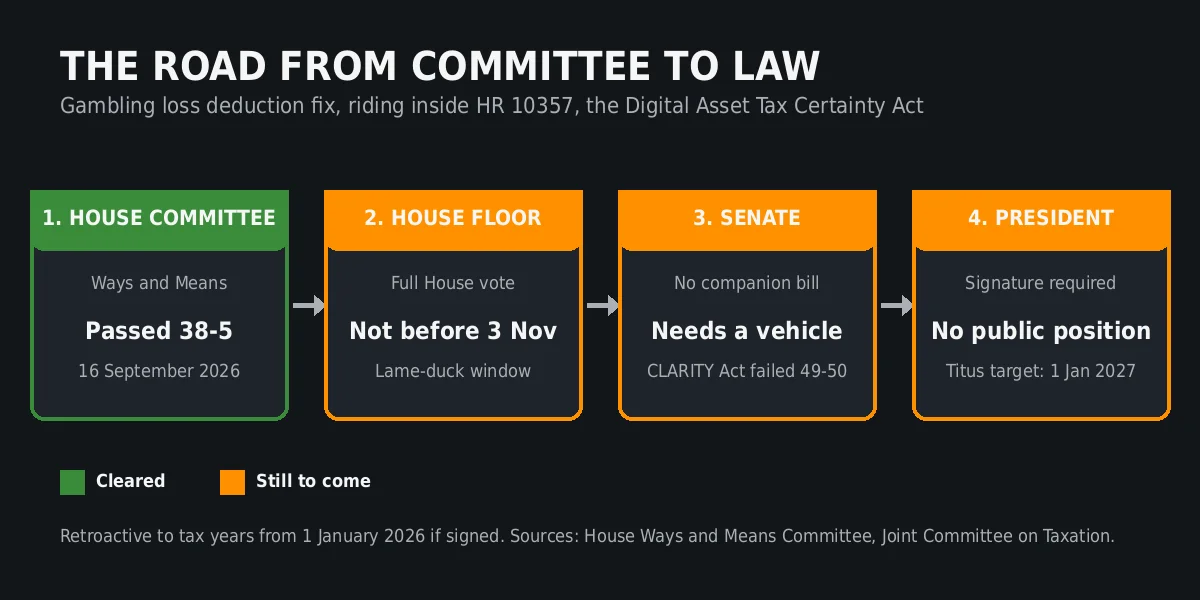
The House Ways and Means Committee voted 38-5 on Wednesday, 16 September, to restore the full deduction for gambling losses. The language of the bipartisan FULL HOUSE Act was folded into a crypto tax package, HR 10357.
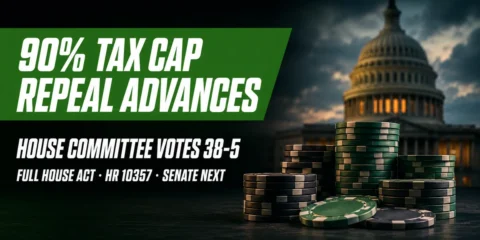
The fix applies to tax years beginning after 31 December 2025, so every 2026 session and every 2026 WSOP cash would be filed under the old 100% rule.
The catch is the vehicle. The provision now sits inside a wide-ranging digital asset bill, the House does not return until after the November midterms, and the Senate refused to open debate on a different crypto bill the day before. Even the five no votes were about crypto, not poker.
The rule has not changed since January: US players can deduct only 90% of gambling losses against winnings, which creates phantom income for anyone who breaks even. Our grinder guide to the phantom income rule covers the mechanics.
What the Committee Actually Passed
Two bill numbers are in circulation and both are correct. HR 6985 is the standalone FULL HOUSE Act. HR 10357 is the Digital Asset Tax Certainty Act that carried its language through committee.
- The vote: 38-5 in the House Ways and Means Committee on 16 September 2026, with every Republican and all but five Democrats in favour.
- The language: the FULL HOUSE Act, introduced in January 2026 by Rep. Steven Horsford (D-NV) and Rep. Max Miller (R-OH). Rep. Dina Titus’s FAIR BET Act, filed in July 2025, was not the text that moved.
- The vehicle: HR 10357, the Digital Asset Tax Certainty Act, introduced by committee chair Jason Smith (R-MO) with Horsford and Miller among eight co-sponsors.
- The effect: the 90% limit on wagering losses is removed for tax years beginning after 31 December 2025, so the whole of 2026 is covered retroactively.
- The cost: the Joint Committee on Taxation puts the repeal at $1.997 billion over 2027 to 2036. The same committee scored the original cap at roughly $1.1 billion of revenue over ten years.
That last pair of numbers is worth a second look. Congress inserted the cap as a budget offset worth about $1.1 billion, and its own scorekeeper now says removing it costs almost double. The wider crypto package still nets the Treasury around $500 million, which made room for the fix.
What It Would Change on a 2026 Return
Losses would once again be deductible up to the full amount of winnings. A player who wins $200,000 and loses $200,000 would owe nothing on gambling income, instead of paying tax on $20,000 that never existed.
Two things stay the same. Net gambling losses still cannot be deducted against other income, and casual players still need to itemise on Schedule A to claim anything at all.
| Item | 2025 rule | 2026 under the cap | If HR 10357 passes |
|---|---|---|---|
| Losses deductible | 100%, up to winnings | 90%, up to winnings | 100%, up to winnings |
| Break-even year | No tax | Tax on 10% of winnings | No tax |
| Net losing year | Excess not deductible | Excess not deductible | Excess not deductible |
| Schedule C expenses | Inside loss limit | Inside 90% haircut | Inside loss limit |
Professionals filing on Schedule C get their travel, buy-ins and software back out from under the 90% haircut as well, because the cap folded business expenses into the limit.
The Five No Votes Were Not About Poker
Politico named the five members who voted against the package: Democratic Reps. Lloyd Doggett (Texas), Judy Chu (California), Gwen Moore (Wisconsin), Don Beyer (Virginia) and Dwight Evans (Pennsylvania). None of the objections reported from the markup concerned the gambling deduction.
- Ethics: Democrats objected to advancing crypto legislation while President Trump’s family crypto business grows, an issue the Senate’s CLARITY Act also stalled on.
- Industry favours: Doggett said the committee was rushing to provide favours to the crypto industry, and called the package billions in tax breaks for it. His three amendments, including one barring senior officials from profiting from crypto, all failed.
- Priorities: several members asked why the panel was spending a markup on digital assets while inflation remains the top voter concern.
- De minimis rules: the $10 exemption for network fees drew specific objections as a giveaway.
In other words, the five were voting against a crypto bill. The gambling fix was a passenger.
What the Poker World Got Wrong
That distinction was lost inside the hour. Daniel Negreanu demanded the five explain why a break-even player should pay tax, and Josh Arieh posted that it took ignorance to vote no “on this”.
The 5 no votes should be forced to explain their logic here and why they think it’s fair and appropriate for people to pay tax when they didn’t make any income.
— Daniel Negreanu (@RealKidPoker) September 16, 2026
Negreanu’s arithmetic is right about the rule. It is just not what the five voted on. No member of either party is reported to have defended the 90% cap on its merits during the markup.
The Gambling Tax Repeal Now Rides a Crypto Bill
Here is the problem with the vehicle. On 15 September, the Senate voted 49-50 against opening debate on the CLARITY Act, the crypto market-structure bill the industry had spent two years lobbying for. It needed 60 votes and fell 11 short.
Senator Cynthia Lummis blamed Democrats for moving the goalposts. Democrats cited the missing ethics provisions. Either way, the chamber that has to pass the bill has, in Politico’s words, barely considered crypto tax issues at all.
- 1. House floor: the House left Washington after the markup and is not scheduled to return until after the 3 November midterms. A lame-duck vote in November or December is the realistic window.
- 2. Senate: there is no Senate companion to HR 10357. The gambling language would need a Senate vehicle, and the last two attempts to attach it to must-pass bills, the defence bill in September 2025 and the January spending package, both failed.
- 3. The President: Trump has not publicly backed restoring the deduction. His December 2025 Air Force One remark, that he would “have to think about” it, was an answer about scrapping tax on gambling winnings altogether, not about the 90% cap.
There is an irony here for our readers. The same framework that would restore your loss deduction also sets the first federal rules for gains on digital assets, which matters to anyone cashing out from the crypto poker rooms where a growing share of US volume now sits.
What Prediction Markets Say About a Repeal
Kalshi has run a contract on the cap being repealed before 2027 since late 2025, and it has spent 2026 pricing a fix as the minority outcome.
| Date | Event | Repeal before 2027 | Source |
|---|---|---|---|
| 21 January | Fix dropped from spending bill | Around 40%, falling | DeFi Rate |
| 13 May | Dana White letter to Trump | 15% to 38% in a day | Covers |
| Mid-May | Letter momentum fades | Settled near 30% | Gambling Insider |
| 16 September | Committee vote | 48% by 1 April 2027 reported | Las Vegas Sun |
The Las Vegas Sun reported more than $3.1 million traded across prediction markets on the question by the day of the vote, with traders implying a 48% chance of repeal by 1 April 2027. A committee vote after 14 months moved the needle, but not past a coin flip.
14 Months of Pushback: The Timeline
The committee vote is the first time any repeal language has cleared a formal hurdle. Everything before it was letters, hearings and failed amendments.
- 4 July 2025: Trump signs the One Big Beautiful Bill Act. The 90% cap sits in Section 70114, inserted in the Senate version as a budget offset. Phil Galfond is among the first to run the maths publicly, and Phil Hellmuth brands it the “Poker Players Death Tax”.
- 7 July 2025: Titus files the FAIR BET Act. Senators Cortez Masto, Rosen and Cruz back a bipartisan Senate effort to do the same.
- August 2025: Doug Polk takes the argument to NewsNation. Read our report on Polk’s mainstream media appearance.
- September 2025: the FAIR BET Act is dropped from the defence spending bill.
- January 2026: the cap takes effect. Horsford and Miller file the FULL HOUSE Act. A push to add the fix to the January spending bill fails.
- April 2026: Erik Seidel tells CNBC the rules are “really untenable” and confirms his semi-retirement from the circuit.
- May 2026: Dana White writes to Trump. Read our breakdown of the Dana White letter.
- 16 September 2026: Ways and Means passes the FULL HOUSE language 38-5 inside HR 10357.
Polk told CNBC in April he expected the real backlash in 2027, “when people actually get the sticker shock” of a first return under the cap. Gambling tax specialist Russ Fox was blunter.
“It’s going to have an impact throughout gambling, which is why I am certain this law will be repealed one day. Don’t ask me if it will be 2026 or 2036.”
The Rakeback Maths Nobody Is Talking About
The rule hits online cash grinders differently from tournament pros, because their edge is thin and a large slice of their profit is rakeback rather than table winnings.
Take a mid-stakes regular with 600 sessions in 2026: winning sessions total $210,000, losing sessions $200,000, rakeback $20,000. Real profit for the year is $30,000.
| Line item | 100% deduction | 90% cap |
|---|---|---|
| Session winnings | $210,000 | $210,000 |
| Deductible losses | $200,000 | $180,000 |
| Taxable table result | $10,000 | $30,000 |
| Rakeback | $20,000 | $20,000 |
| Taxable income | $30,000 | $50,000 |
| Phantom income | $0 | $20,000 |
The phantom income is the same size as the rakeback. Every dollar the room gives back is matched by a dollar of tax on money the player never won. Push the volume up to a $500,000 gross and the phantom line passes $50,000.
What US Grinders Should Do Before 31 December
The repeal is retroactive if it passes and worthless if it does not. The advice from tax professionals is the same in both cases.
- Keep every session record. A contemporaneous log is what makes losses deductible under either rule. Without it there is nothing to restore.
- Do not plan around a repeal. The cap is current law for 2026 until the President signs something. Budget for it.
- Know the amended-return route. If the repeal passes after you have filed, the overpaid tax can be recovered on an amended return. Players without records get nothing back.
- Watch the lame-duck calendar. The House returns after 3 November. Any floor vote, Senate action or White House statement changes the picture, and we will update this article when it does.
For now, the headline is simple. The 90% gambling tax repeal has passed its first real test by 38 votes to five, and its fate now belongs to a crypto bill in a Senate that turned one down on 15 September.
The stakes at the top end are already visible. This year’s Main Event final table lost an estimated $12.3 million to tax before the cap entered the maths, and our breakdown of what each finalist kept shows why a 10% haircut on losses matters at every stake.
Der Beitrag 90% Gambling Tax Repeal Passes Committee 38-5, Now Rides a Crypto Bill erschien zuerst auf VIP-Grinders.
About The Author