
In April 2026, Dylan Linde revealed that David Peters, a player with nearly $50 million in career earnings, had spent months avoiding a $50,000 staking debt. Peters apologized publicly and repaid $27,000. The rest is still outstanding.
Peters is not an outlier. A Japanese high-stakes regular vanished owing an alleged $15 million. A lawyer who argued 44 cases at the US Supreme Court is now serving six years for tax evasion and for hiding his poker debts from mortgage lenders, and an Australian pro was taken to court by his backers over AU$400,450, arguing that as a problem gambler he never had the capacity to agree to the deal.
Poker runs on handshake deals. Staking, backing, borrowing mid-session: almost none of it is written down, and almost none of it can be enforced when someone decides not to pay.
This is our ranking of the biggest poker debts and scams in the game’s history, with verified amounts and what happened to everyone involved. Every case is labeled Court Confirmed, Charged, In Litigation, Admitted, or Allegation Only, so you always know the difference between a conviction and a Twitter accusation, updated for 2026.
Every Poker Debt and Scam, Ranked by Amount
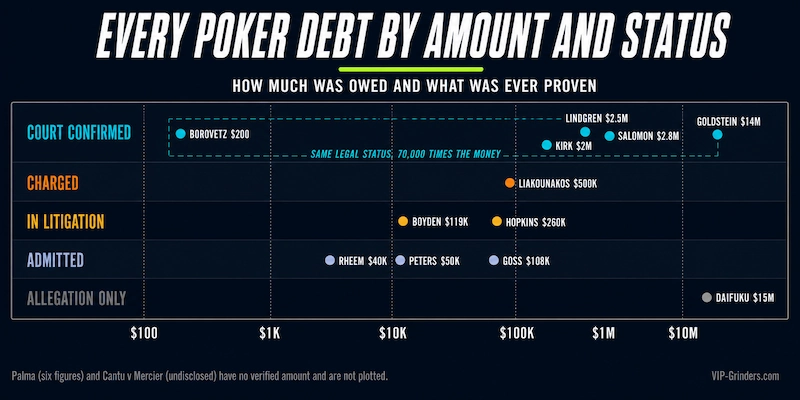
Every major poker debt scandal and staking scam since 2010 is ranked by amount below. The full breakdown of each case follows.
| Case | Year | Amount | Type | Status |
|---|---|---|---|---|
| Ryusuke Daifuku | 2022-2023 | ~$15M* | Unpaid debts | Allegation only. Nothing recovered |
| Tom Goldstein | 2016-2026 | $14M+ concealed | Concealed debts | Court confirmed. Six years in federal prison |
| Rick Salomon vs Raad al-Khereiji | 2014-2019 | $2.8M | Unpaid poker debt | Court confirmed. Debt ruled unenforceable |
| Erick Lindgren | 2012-2015 | $2.5M litigated | Unpaid debts | Court confirmed. Discharged in bankruptcy |
| Matt Kirk vs Leon Tsoukernik | 2017-2018 | $2M | Unpaid loan | Court confirmed. Ruled unenforceable, case dismissed by agreement |
| Filippos Liakounakos | 2020-2022 | $500,000 | Alleged crypto theft | Charged. Disposition unknown |
| James Hopkins | 2018 | AU$400,450 (approx. US$260,000) | Staking dispute | In litigation. No known outcome |
| Tom Boyden (Grip Genie) | 2021 | $119,459 | Alleged embezzlement to fund staking | In litigation. No known outcome |
| Grayson Hunter Goss | 2022 | $108,000 owed | Loan and betting scam | Admitted. Not repaid |
| David Peters and Dylan Linde | 2025-2026 | $50,000 | Staking debt | Admitted. Partially repaid |
| Chino Rheem | 2010-2025 | $40,000+ per creditor | Unpaid loans | Admitted. Partially repaid |
| Michael Borovetz | 2014-2019 | Small sums, 43+ incidents | Loan scams | Court confirmed. Pleaded guilty, sentence not reported |
| Nicholas Palma | 2018-2020 | Six figures* | Staking and backing debts | Allegation only. Nothing recovered |
| Brandon Cantu vs Jason Mercier | 2019 | Undisclosed | Unpaid debt | Admitted. Never confirmed as repaid |
*Amounts marked with an asterisk are alleged by accusers and have never been independently verified.
The Biggest Unpaid Debts in Poker
These are the largest sums one poker player has been accused of taking from another and never giving back. Some ended in court. Most ended in nothing at all, because a handshake between two players at a table is rarely a contract a court will enforce.
Ryusuke Daifuku: The $15 Million Disappearance
Status: Allegation only. Nothing recovered.
Ryusuke Daifuku was a Japanese high-stakes regular who played on Hustler Casino Live during 2022, winning a recorded $684,000 across roughly 12 weeks. He was at the table for the infamous Adelstein and Robbi Jade Lew hand in September 2022. Then he vanished.
In spring 2023, Nik Airball named him on a live HCL stream, saying Daifuku owed him $160,000 personally and roughly $500,000 to players in the Los Angeles area. Another regular on the same broadcast said a friend was owed a six-figure sum and offered a bounty for information on his whereabouts.
- Verified on record: roughly $500,000 in named, on-camera claims from LA players.
- Alleged total: around $15 million including debts in Japan, a figure publicized by Doug Polk but never independently verified.
- Last sighting: reportedly playing $5/$10 in Sihanoukville, Cambodia.
- Recovered: nothing. No lawsuit, no charges, no repayment.
Daifuku has never responded publicly to any of the accusations. No creditor has filed suit, which is unsurprising: the debts were handshake deals in private games, spread across two countries, with no contracts behind them.
This is the largest alleged figure on this page and also the least verified. What is documented is the roughly $500,000 in named claims from players who said it on camera. The $15 million total exists only as an accusation.
Rick Salomon vs Raad al-Khereiji: $2.8 Million
Status: Court confirmed. Salomon lost, debt ruled unenforceable.
In 2014, Rick Salomon won $2,800,000 from Saudi businessman Raad al-Khereiji in a private Texas Hold’em game at the Tiara Miramar Beach hotel near Cannes. Al-Khereiji told Salomon his lawyer in Los Angeles would arrange payment.
Seven months later, that lawyer said there would be no payment at all. Al-Khereiji’s position was that the session had been a friendly game with no financial stake.
Salomon sued in France. The case went to trial in Grasse in October 2019, and the verdict landed that December.
- The court ruled against Salomon under a French law dating to 1804, which allows courts to enforce gambling debts only where the game involves physical exercise.
- Salomon’s lawyer argued the game qualified because it ran for 48 hours straight. The judge disagreed, finding poker a game of chance.
- Salomon’s team obtained al-Khereiji’s Las Vegas gambling records, which showed he had lost $34 million over 29 months in the Ivey Room at the Aria, where the minimum buy-in was $100,000.
- Several players present at the game testified that they heard al-Khereiji promise payment. It made no difference to the ruling.
Salomon’s lawyer said they were considering an appeal to the French supreme court, noting there had been no case law on the 1804 rule since it was written.
This is the most important ruling on this page, and Salomon lost it. He had witnesses, he had the defendant’s gambling records, and he had a promise made in front of a room full of people. None of it mattered, because in France a poker debt is not a debt the courts will collect.
Erick Lindgren: $2.5 Million and Two Bankruptcies
Status: Court confirmed. Litigated and discharged.
Erick “E-Dog” Lindgren was one of the biggest names in poker during the boom years, with a Full Tilt sponsorship and more than $10 million in tournament earnings. In March 2012, a TwoPlusTwo thread started by Haralabos Voulgaris exposed years of unpaid debts across the poker community.
Lindgren was candid about the scale of it. He told Bluff Magazine his debts had “climbed as high as $10 million at one point,” and that he had been “probably $6 million in debt in ’04” before paying back around $3 million of it.
- January 30, 2015: PokerStars (via the Rational Group) sued Lindgren in Nevada federal court for $2.5 million.
- The claim covered a $531,807 loan plus a $2 million duplicate payment sent in error by Chris Ferguson on April 18, 2011.
- Lindgren filed for bankruptcy twice. The 2015 Chapter 11 filing listed debts of over $8 million against under $50,000 in assets.
- He later entered treatment for gambling addiction.
“I tried calling him maybe a dozen times… he never paid it back… ever.”
Howard Lederer on Lindgren’s Full Tilt loan
Lindgren’s case is different from most on this page. He did not scam anyone or take money under false pretenses. He lost enormous sums betting on sports, borrowed to stay in action, and eventually could not cover what he owed.
That distinction matters, but it did not help the people he owed. The debts were real, the money was gone, and bankruptcy discharged most of what remained.
Matt Kirk vs Leon Tsoukernik: The $2 Million Poker Loan
Status: Court confirmed. Ruled unenforceable, case dismissed by agreement.
In May 2017, Australian high-stakes pro Matt Kirk sat down for a late-night heads-up game at the Aria in Las Vegas against Leon Tsoukernik, the Czech businessman who owns King’s Casino in Rozvadov. Tsoukernik was losing heavily and, by his own lawyers’ account, drinking.
Kirk kept lending him money to keep the game running. That is ordinary enough at those stakes, and it is exactly where the trouble starts.
- May 2017: across one late-night session in the Ivey Room at the Aria, Kirk advanced Tsoukernik a total of $3 million. Tsoukernik lost all of it.
- May 27, 2017: the two met poolside at the Aria with poker businessman Rob Yong present. Tsoukernik’s filing says Kirk shook hands there on $1 million as full and final settlement.
- June 2017: Tsoukernik paid the $1 million. Kirk sued in Clark County for the remaining $2 million.
- Later that year: Tsoukernik countersued, alleging Kirk had worked with the Aria to keep him drinking, and claimed damages above $10 million.
District Judge Linda Marie Bell threw out eight of Kirk’s ten claims and ruled the $2 million an unenforceable gambling debt. The form the money took made no difference to her reasoning.
“Whether in the form of casino chips, cash, or gold bars”
District Judge Linda Marie Bell, ruling that the loan was made for wagering
She did not dismiss the case outright, and that distinction matters. Kirk was left free to pursue the money on grounds of fraudulent inducement and unjust enrichment, so Nevada stopped short of the door France slammed on Salomon.
The countersuit went nowhere. Bell rejected the claim that the Aria and Kirk had conspired to keep Tsoukernik drinking, and ordered Tsoukernik to cover Kirk’s legal costs on it.
Then the case simply stopped. In July 2018 both sides jointly asked the court to dismiss it with prejudice, each bearing its own costs. The order covered Kirk’s complaint, Tsoukernik’s counterclaims and the third-party claims against the Aria.
Nothing in the court file says whether the $2 million was ever paid. A post on the 2+2 forum claimed the two settled amicably out of court, and that forum post remains the only public account of how the case actually resolved.
Three months before that filing, the two men sat down together again at the partypoker Big Game in Montreal. Kirk lost roughly $4.7 million across the series. Tsoukernik finished up about $3.5 million.
That is the pattern worth noticing. The court declined to enforce the debt, the parties settled it privately on terms nobody has ever published, and the two of them went back to playing.
Grayson Hunter Goss: The Disney Star Who Scammed Ludwig for $108,000
Status: Admitted. Not repaid.
Grayson Hunter Goss is a voice actor best known for Disney’s Sofia the First. In 2022 he became one of the most publicly exposed scammers in the poker world, and the amounts involved were not the reason why.
- June 2022: poker vlogger Ethan Rampage Yau said Goss borrowed $1,000 and stopped responding. Goss claimed he had been mugged for $12,000.
- August 2022: streamer Ludwig Ahgren revealed Goss had taken him for far more. After meeting in Las Vegas, Ludwig sent $50,000 for what Goss described as a fixed French Open match.
- The bet won. Goss owed at least $108,000 back, and paid none of it.
- Ludwig hired a private investigator. Goss eventually admitted the scam, and there is no public record of repayment or of any criminal case.
The $1,000 from Rampage is what made the story spread. A man willing to burn his reputation over four figures is a different kind of risk from someone who overextends on a big score.
Goss had no poker results to trade on and no standing in the community. He borrowed against a public persona instead, and it worked twice before anyone compared notes.
David Peters and Dylan Linde: $50,000
Status: Admitted. Partially repaid, balance outstanding.
On April 21, 2026, Dylan Linde published a thread on X explaining why he regretted doing business with David Peters. Peters has close to $50 million in career tournament earnings and one of the best reputations in the high roller community.
The dispute was not about a loan. It was about a staking arrangement that ran the wrong way, which is the most common way poker debts start.
- Summer 2025: Peters bought a piece of Linde’s $50,000 PLO High Roller at the WSOP. Linde won the event for $2,146,414 and paid Peters out in cash within days.
- September 2025: at Triton Jeju, Peters bought pieces of Linde’s two main events and asked to settle after the series, citing low liquidity at the event. The action lost $50,000.
- Poker Masters, then NAPT Bahamas: two agreed settlement points came and went. Peters did not show at either.
- February to April 2026: Peters paid $12,000, then a further $15,000 on April 1, then said he could not cover the remaining $23,000.
Linde said he only went public after learning of other unpaid debts and bad business deals involving Peters, and felt obliged to warn people.
Peters responded the following day and did not dispute any of it.
“I deeply regret the choices that I made.”
David Peters, April 22, 2026
He described getting into a bad situation, doubling down, and communicating poorly while missing every timeline he set. He committed to paying Linde in full without giving a date.
As of July 2026, there is no public confirmation that the balance has been settled.
The response from other players split. Garrett Adelstein defended his character publicly, while others pointed out that a man with $50 million in cashes was arguing over $23,000.
That is the part that unsettled people. Peters played nine events at Triton Jeju in September 2025, cashing once for $118,000 against at least $630,000 in buy-ins, then missed the PokerGO High Roller series, WSOP Paradise, and the spring Triton stop. His only cash of 2026 before the thread was $13,800 at the WPT Venetian.
For the full timeline and the complete text of both statements, see our report on the Peters and Linde staking dispute.
Chino Rheem: The Unpaid Debts Behind “Chino’d”
Status: Admitted. Partially repaid.
No player is more associated with unpaid poker debts than David “Chino” Rheem. Despite more than $10 million in career earnings and titles including the 2013 WPT Championship and the $1.5 million 2019 PCA Main Event, his name became shorthand for taking money and not giving it back.
The pattern was public by 2011, when Will Molson posted on TwoPlusTwo that Rheem owed him $40,000 after an accidental double transfer of a $20,000 loan. Joseph Cheong was owed a similar amount and Tom Dwan was reportedly owed an undisclosed sum.
- 2013: Guy Laliberte backed Rheem’s $111,111 entry into the One Drop High Roller at the WSOP. Rheem never entered, lost the money at the baccarat tables, and had reportedly also sold shares of himself in the same event.
- 2011: days after the Molson thread went public, Rheem won the inaugural Epic Poker League Main Event for $1 million.
- He kept almost none of it. He was backed for 70%, another 10% went to charity, and PokerNews reporters described a line of creditors waiting at the payout cage. Ben Lamb confirmed publicly that he was paid in full.
- The EPL placed him on probation immediately. In October 2025 he was still winning, taking down the PokerGO Tour PLO Series II.
Rheem is the clearest example of how poker’s credit system fails. The community knew, talked about it constantly, and kept lending to him anyway, because he was talented enough that the next score always looked close.
The verb “Chino’d” entered poker slang. That is a heavier penalty than any tour ever imposed on him.
Brandon Cantu and Jason Mercier: The Debt Chain
Status: Admitted. Never confirmed as repaid.
Jason Mercier has six WSOP bracelets, more than $22 million in career earnings, and a 2016 Player of the Year title. He also spent years publicly chasing money he said Brandon Cantu owed him.
Mercier called Cantu a “deadbeat” on Twitter and said the debt had gone unpaid for three and a half years without a single payment. Cantu, who has more than $4.2 million in live cashes and once dominated high stakes open-face Chinese games, did not deny owing the money.
His defense was that he could not pay because he had not been paid either.
“owed about a million from other TOP TOP Poker players”
Brandon Cantu, on why he could not settle with Mercier
Unlike Mercier, he refused to name any of them.
That defense is the most honest description of how poker debt actually works. Money owed at the top of the chain stops moving, and everyone below it stops paying too. Nobody involved has a contract, so the only options are to wait, write it off, or post about it.
Mercier never named a figure publicly. On December 31, 2019, he posted a general appeal to the poker community to settle up before the decade ended, without naming anyone at all.
Neither man has confirmed the debt was ever paid.
Poker Staking Scams and Backing Disputes
Staking is how most professional poker gets funded. A backer covers the buy-in, the player returns the stake and splits the profit, and losses carry forward against future wins. Almost none of it is written down, which is why these disputes usually end up on social media rather than in a courtroom.
James Hopkins: AU$400,450 and the Enforceability Question
Status: In litigation. No known outcome.
Australian online pro James Hopkins, who has roughly $1.07 million in online winnings under the name “cmon_gasquet”, was sued by Aidan Hildebrandt and his family over money advanced to him and his company Pocket Punting Pty Ltd.
It started with a $40,000 loan in January 2018, repayable with $14,000 in interest. Eleven more loans followed. The claim eventually reached AU$400,450.
Hopkins did not argue that he had repaid the money. His defense was that he is a problem gambler who lacked the capacity to properly understand the arrangement, and that the Hildebrandts should never have trusted him with it in the first place.
Tom Boyden: The $119,459 Poker Staking Lawsuit
Status: In litigation. No known outcome.
Most poker debts start inside poker. This one started in a fitness equipment company and ended up on a poker table.
- Boyden was co-owner of Grip Genie, a fitness equipment company founded with bodybuilding YouTuber Jon Jujimufu Call and Erin Borsodi.
- The lawsuit alleged he took $119,459.08 from company accounts, some of it to fund a gambling habit and to stake poker player Shaun Downey.
- It also alleged roughly $172,000 in loans taken out in the company’s name without authorization.
- Boyden posted an apology and then deleted it. He left the company, and the case was filed in the North Carolina Business Court in 2021.
The case is worth including because of where the money came from. Backers are usually other poker players who understand the risk they are taking. Here the money belonged to business partners who had no idea they were funding anyone’s action.
Nicholas Palma: Six Figures in Backing Disputes
Status: Allegation only. No lawsuit, no charges.
Nicholas Palma is a tournament professional with around $1.53 million in live cashes. Since 2018 he has been publicly accused by several people of taking backing money and not returning it.
The accusations began with Tim Reilly and were later echoed by Alex Foxen. Here is where it stands.
- The accusers: Tim Reilly first, echoed later by Alex Foxen, with Ralph Massey raising it again publicly in January 2020.
- The allegation: investment taken for tournaments, cashes kept that should have been shared, and losses left sitting with the backers.
- Verified amount: none. The six-figure totals come from the accusers alone and no independent number exists.
- Outcome: no lawsuit, no charges, no repayment. The staking platform YouStake acted against his account, and Palma disputes the accusations.
Eight years on, none of it has been tested anywhere except online.
When a Poker Debt Becomes a Crime
Almost nothing on this page has reached a criminal court. Poker treats unpaid money as a community matter, settled by reputation rather than by police. These three cases are where that stopped being true.
Only one of them is a conviction for taking money and not giving it back, and the sums involved were trivial. The largest case here ended in six years in federal prison, but he was convicted of hiding what he owed rather than of failing to pay it.
None of these cases involves cheating at the tables. Manipulating the game itself is a separate problem with a separate history, covered in our guide to poker cheating scandals.
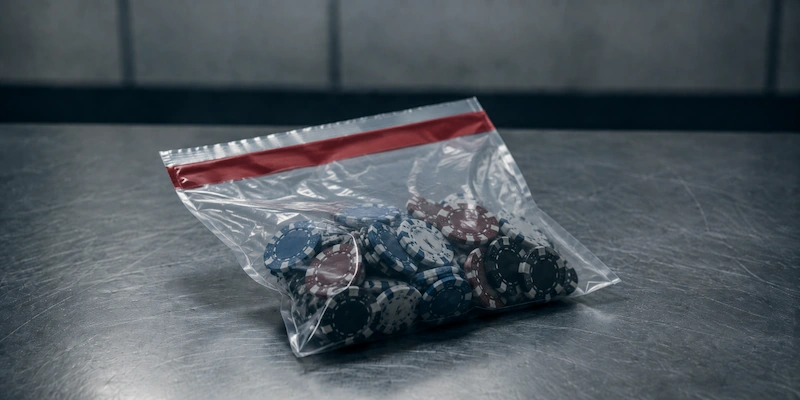
Filippos Liakounakos: The $500,000 Bitcoin Theft Charges
Status: Charged. Three felony counts, disposition unknown.
Filippos Liakounakos was a 23-year-old part-time pot limit Omaha player. Police say that in November 2020 he arranged a Bitcoin trade on Telegram while posing as one of the victim’s business associates.
The victim sent $500,000 in Bitcoin, including a $50,000 fee for the supposed seller. Blockchain analysts traced the coins being split into progressively smaller amounts to obscure the trail, a laundering technique known as peeling.
He was never going to be caught on that alone. He was caught because he went back.
Liakounakos attempted a second transaction with the same victim, this time for close to $999,900. That attempt is what unraveled the first one. He was arrested in Las Vegas on March 28, 2022 and booked at the Clark County Detention Center.
- Theft of more than $100,000.
- Identity fraud, using another person’s identity to cause a financial loss of more than $30,000.
- An unlawful act involving electronic communications, covering the transmission of computer data.
- Bail was set at $250,000.
This is the only case on the page that was never a debt at all. No loan was made, no stake was sold, and the two men had no relationship beyond a Telegram conversation. Police allege someone impersonated a business associate and took half a million dollars.
Michael Borovetz: The Airport Scams That Funded a Poker Career
Status: Court confirmed. Pleaded guilty, sentence not reported.
Every other case on this page runs from five figures to eight. Michael Borovetz worked in hundreds of dollars at a time, and he pleaded guilty to it.
The routine never changed. He approached strangers in airport terminals with a story about a canceled flight or a lost wallet, asked for a small loan, promised to pay it back, and disappeared.
“approaching passengers with a sad story in an attempt to get money”
Detroit Metropolitan Airport officials, on Borovetz’s method
The money went into tournament buy-ins, including at the WSOP.
- 2014: outed on TwoPlusTwo for working the Las Vegas airport. Borovetz joined the thread himself, admitted it, and said it was time for a permanent change in his life.
- 2018: arrested at Newark after taking $200 from a 55-year-old traveler who thought better of it and called the Port Authority.
- August 2019: arrested at Detroit Metro, where airport police had wanted him for four years, after a tip about a connecting flight from Seattle to Miami.
- The scale: one complaints site logged at least 43 separate incidents, and he has been arrested for the same routine in 13 states.
Borovetz was not an unknown player scraping by. He has a WSOP Circuit ring and $589,958 in recorded live tournament earnings, and he was still posting cashes in 2018 while the arrests were piling up.
In October 2019 he pleaded guilty in a Michigan court to a single count of theft by false pretenses. Sentencing was set for December 12, 2019, and no outcome was ever reported. He had already served time awaiting the hearing, so time served plus probation was the expected result.
Borovetz sits near the bottom of this page on money and near the top on legal certainty. The difference is not the amount. His victims were strangers in an airport rather than other poker players, so they called the police instead of posting about it.
A man took $200 from a traveler in Newark and was arrested for it, while others on this page walked away from far larger sums with nothing worse than a reputation.
Poker handles its own money internally, and it handles it badly. The case that follows is what happens when someone outside poker starts looking.
Tom Goldstein: The $14 Million He Hid From Mortgage Lenders
Status: Court confirmed. Sentenced to six years in federal prison.
Tom Goldstein argued 44 cases before the United States Supreme Court and co-founded SCOTUSblog. On July 24, 2026 he was sentenced in a federal court in Greenbelt, Maryland, and taken into custody in the courtroom.
He was not convicted of failing to pay a poker debt. He was convicted of hiding what he owed, and of not paying tax on what he won.
- Six years in federal prison, followed by five years of supervised release.
- $3,103,427 in restitution, plus forfeiture in an amount the court left open.
- Taken into custody the same day. The judge revoked his bond and refused bail pending appeal, so there is no self-surrender date.
- Twelve convictions from sixteen counts: one of tax evasion, four of failing to pay tax on time, four of assisting false returns, and three of making false statements to mortgage lenders. Eight are felonies.
The debt figures come from two different documents and they do not match exactly. The IRS recorded more than $14 million in poker debts held across two promissory notes, which he left off his 2021 mortgage applications. The indictment described a $15 million gambling debt concealed from the same lenders.
One of those notes traces straight back to a poker table. Goldstein lost heavily to real estate investor Bob Safai across their 2017 matches, and in 2018 signed a promissory note for roughly $6 million he had still not paid.
No source states that the $14 million and the $15 million figures describe the same liability. They cover the same year and the same applications, which makes it likely, but likely is not confirmed and this page does not treat it as such.
The concealment worked. He obtained a $1.98 million loan on a $2.6 million home in Washington, D.C.
Prosecutors said he hid more than $25 million in income between 2016 and 2023 and cost the Treasury over $9.5 million. The restitution actually ordered was $3,103,427, which reflects the counts he was convicted on rather than the government’s full estimate of the loss.
“I have betrayed the trust of people who really loved me”
Tom Goldstein, addressing the court before sentencing
The poker behind it was played at a level almost nobody on this page reached. He won roughly $50 million across heads-up matches in 2016, and a further $51.4 million net from Texas billionaire Andy Beal between May 2022 and May 2024.
He kept far less than that suggests. Investors were taking around 75 percent of the winnings, and he told jurors he is down roughly $10 million on poker across his career.
That is the detail worth sitting with. A man who moved eight figures at a time through other people’s money ended up in prison not for any of it, but for what he told a bank about it afterward.
He has said he intends to appeal.
For the full account of the trial, the verdict and the sentencing, see our report on the Tom Goldstein case.
How Poker’s Credit System Actually Works
Almost every case above starts the same way. Money moves between two people who trust each other, on terms nobody writes down, in an industry with no mechanism for collecting when it goes wrong.
Understanding the vocabulary makes the failures easier to see. Here is what the money is actually doing when a poker player says they are staked, in makeup, or selling action.
| Term | What it means | Where it fails |
|---|---|---|
| Staking | A backer covers the buy-in and takes an agreed share of any cash | Nothing obliges the player to hand over the backer’s share after a win |
| Makeup | Losses carry forward and must be cleared from future wins before profit is split again | A player deep in makeup has every reason to walk away and start fresh with someone else |
| Markup | The player sells action above face value, charging 1.2 for every 1.0 of equity | Arguments about what was agreed, usually after the result is known |
| Swaps | Two players trade small percentages of each other before an event | Agreed verbally, often minutes before cards are in the air |
| Backing deal | A longer arrangement covering a full series, or a year | The biggest sums on the loosest paperwork |
None of this is unusual or improper. It is how professional poker is funded. The summary above is deliberately brief, because our full guide to how poker staking works covers profit splits, markup and the mechanics properly.
The problem is the enforcement layer, because there isn’t one. A backer who is stiffed has no contract, no regulator, and no realistic route to a courtroom, as Rick Salomon and Matt Kirk both found out.
So the industry substitutes reputation. That works while the player still needs the community, and it stops working the moment they decide they don’t.
There is one more reason these debts get so large before anyone notices. A player who is losing borrows to stay in action, and the person lending is usually another player who understands exactly why, which makes refusing feel unreasonable.
Erick Lindgren described debts reaching eight figures. Chino Rheem kept finding new creditors for years after the first thread went public. In both cases the community knew and lent anyway.
Anyone playing for money should read this next to our guide on bankroll management, because the players who end up on lists like this one almost always got there by playing above their roll first and borrowing second.
The Poker Scam Accusation That Became an Extortion
Every case above involves money that went missing. This one is here because of what happened after the accusation, and because of how fast the poker community convicts someone when the story is good enough.
In 2023, Hustler Casino Live regular Wenzhi “Wesley” Fei was accused online of running a cryptocurrency scheme that cost an investor $250,000. The accusation also claimed he had sent men to break into the accuser’s home to take evidence. Fei denied all of it.
The claim spread quickly, and a large part of the poker world treated it as settled fact within days.
- June 2023: Lee is contacted anonymously by someone claiming a crypto project of Fei’s had cost them $250,000, asking for help exposing him.
- September 2023: a website goes live setting out the accusation. A Reddit post is read by more than 200,000 people within a day. Fei denies all of it.
- Then the story changes: the anonymous accuser tells Lee his own life is in danger, and that money is needed to buy documents proving fraud.
- After the payments: Lee learns the evidence does not exist. HCL co-founder Ryan Feldman brings the two men together to work out what actually happened.
The player caught in the middle was fellow HCL regular Benjamin “Blank Check Ben” Lee, who had a strained relationship with Fei and was approached precisely because of it.
Lee believed he was funding the purchase of evidence that would expose a fraud. He sent the money in cryptocurrency, in three installments, through a friend in London who handed over cash in person.
“I sent £30,000 in cryptocurrency (broken down into 3 separate payments)”
Benjamin Lee, on the money he paid chasing evidence that did not exist
There was no evidence and no whistleblower. Lee and Fei had been played against each other by the same person, and they only worked it out by comparing notes with Feldman in the room.
The two are now on speaking terms, which is more than most people on this page can say about their counterparts.
Where the original accusation stands is the part worth being precise about. No fraud charges have ever been filed against Fei, and no regulator has taken any action over the crypto project or anything else. Those claims remain unproven allegations rather than legal findings, and Fei continues to deny them.
That is not the same as saying they were disproven. It is the honest position, and it is the reason this case sits in its own section rather than in the table above.
What Poker’s Biggest Debt Disputes Teach Backers
Nothing above happened because the people involved were unusually careless. It happened because poker’s default is a verbal agreement between two people who like each other, and that default holds right up until it doesn’t.
You cannot make a staking deal enforceable. What you can do is remove the ambiguity that turns a disagreement into a year of silence.
What a Staking Agreement Should Actually Say
Seven points. If all seven are written down somewhere before money moves, most of the disputes on this page could not have started.
- 1What the money covers. Buy-in only, or re-entries, travel and expenses as well. A surprising number of disputes start here.
- 2The split. The percentage of any cash the backer receives, written as a number rather than assumed from a previous deal.
- 3Markup, stated explicitly. If action is sold above face value, the rate belongs in the agreement, not in someone’s memory of a conversation.
- 4Makeup terms. Whether losses carry forward, what clears them, and whether they follow the player if the deal ends.
- 5A settlement date. An actual date, not “after the series”. Vague timing is how a debt becomes a year old without anyone deciding it should.
- 6An exit clause. How either side ends the arrangement, and what happens to outstanding makeup when they do.
- 7A written record. A message thread is not a contract, but it beats a handshake, and it is what you will be relying on if this goes wrong.
Warning Signs, and Where They Showed Up
None of these are hypothetical. Every one of them appears somewhere on this page.
| Warning sign | Where it appeared |
|---|---|
| Settlement keeps moving to the next series | Peters missed two agreed settlement points before Linde went public |
| Money lent mid-session to someone who is losing | Kirk advanced $3 million across a single night at the Aria |
| Deals struck with someone who has been drinking | Tsoukernik’s entire defense rested on it |
| Non-payment blamed on money owed further up the chain | Cantu said he was owed about a million himself |
| A reputation that is already an open secret | Rheem was discussed openly for years and kept finding new creditors |
| Repeat lending to cover the last shortfall | Hopkins took twelve separate loans before the Hildebrandts stopped |
What to Do When Someone Does Not Pay
The honest answer is that your options are poor, and they get worse the longer you wait. Rick Salomon had witnesses, records and a promise made in front of a room, and none of it worked.
Ask for settlement at the point you agreed, on the day you agreed it. A backer who lets the first missed date pass without comment has just taught the other person that dates are negotiable.
Keep the record. Screenshots of the original terms cost nothing and are the only thing that distinguishes a debt from a disagreement about what was ever promised.
If the deal ran through a staking platform, use it. Those platforms can restrict accounts and flag users, which is the closest thing to enforcement that exists, and it is what YouStake did with Nicholas Palma’s account.
That leaves going public, which is what almost everyone on this page eventually did. It works, in the sense that reputation is the only currency poker actually enforces.
It also ends the relationship, guarantees that some people will take the other side, and rarely produces the money. Dylan Linde recovered $27,000 of $50,000, and only after seven months of missed settlement dates.
Poker Debts and Scams FAQ
The questions people ask most often about poker debts, staking disputes and what actually happens when someone does not pay.
What is the biggest unpaid debt in poker history?
The largest figure ever alleged is around $15 million, said to be owed by Japanese high-stakes regular Ryusuke Daifuku, though that total has never been independently verified. What is documented is roughly $500,000 in named, on-camera claims from players in Los Angeles. The largest player-to-player poker debt ever fully litigated is Rick Salomon’s $2.8 million claim against Raad al-Khereiji, which a French court declined to enforce in 2019.
Are poker debts legally enforceable?
In the cases that have been tested, mostly not. A French court ruled against Rick Salomon in 2019 under a law dating to 1804 that enforces gambling debts only where the game involves physical exercise. A Nevada judge called Matt Kirk’s $2 million loan an unenforceable gambling debt. Enforceability varies by jurisdiction, and anyone in this position should take proper legal advice on their own situation.
Has any poker player gone to prison over an unpaid debt?
Not for the debt itself. Tom Goldstein was sentenced to six years in July 2026, but for tax evasion and for lying to mortgage lenders about what he owed, rather than for failing to repay it. Michael Borovetz pleaded guilty in October 2019 to theft by false pretenses over small loans taken from strangers at airports, and no sentence was ever publicly reported. Most poker debts never reach a criminal court because the money was handed over voluntarily.
What does “Chino'd” mean in poker?
It is poker slang for being owed money by someone who does not pay it back. The term comes from David “Chino” Rheem, who has more than $10 million in career earnings and became associated with unpaid debts to other players from around 2011 onward.
What is makeup in poker staking?
Makeup is the running total of losses a staked player must clear from future winnings before profits are split again. A player who is deep in makeup has already cost their backer money and has little short-term upside, which is why makeup is one of the most common triggers for a staking arrangement breaking down.
Did David Peters pay Dylan Linde back?
Not in full. Peters paid $27,000 of the $50,000 across February and April 2026, then said he could not cover the remaining $23,000. As of July 2026 there is no public confirmation that the balance has been settled.
Can you sue someone for an unpaid poker staking debt?
You can file a claim, but the results on record are discouraging. James Hopkins was sued by his backers in Australia over AU$400,450 and Tom Boyden was sued in North Carolina over $119,459, and neither case has a publicly reported outcome. Courts in France and Nevada have both declined to enforce poker debts between players.
How do you protect yourself when staking a poker player?
Write down what the money covers, the percentage split, any markup, whether makeup carries forward, and a specific settlement date rather than a vague one. Keep the agreement in a message thread if nothing else. If the deal runs through a staking platform, that platform is the only realistic enforcement mechanism available.
What is the difference between a poker debt and a poker scam?
A debt is money that was lent or staked in good faith and not repaid, which describes most cases. A scam involves deception at the point the money changes hands, such as Grayson Hunter Goss taking $50,000 for a bet he described as fixed. The distinction matters legally, because deception can be a crime while an unpaid debt usually is not.
Der Beitrag The Biggest Poker Debts and Scams of All Time erschien zuerst auf VIP-Grinders.
About The Author


